
Commercial Solar · Birmingham & the West Midlands
Commercial solar panels in Birmingham, with a 3-year payback.
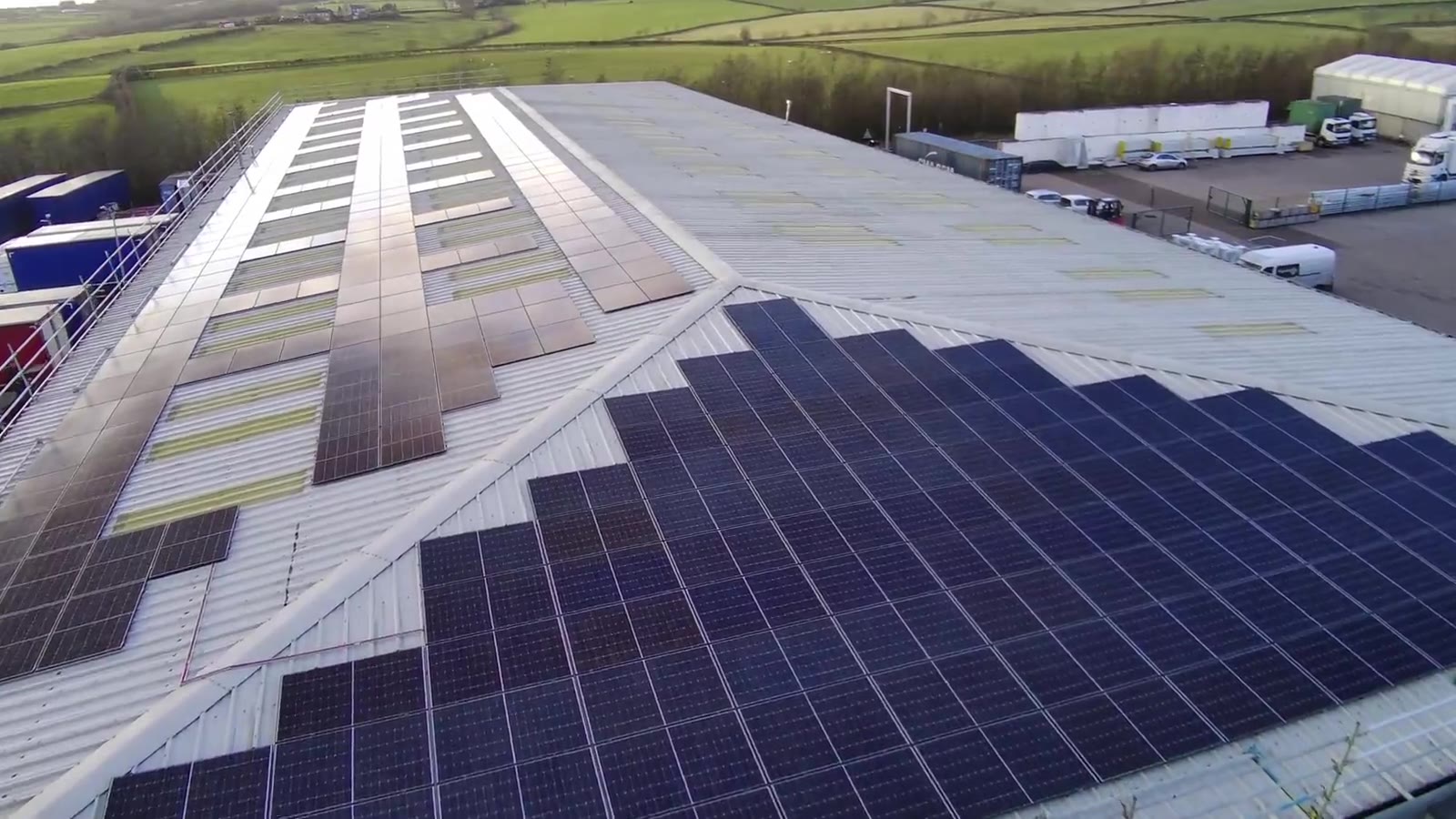
Green Tech Hub designs and installs commercial solar panels in Birmingham and across the West Midlands from our base in Oldbury. Energy prices up, panel costs down: many of our commercial designs now pay for themselves in around three years. We handle everything, CAD design, planning, the grid application, installation and lifelong aftercare, with directors on every project.
Why now
The economics have flipped.
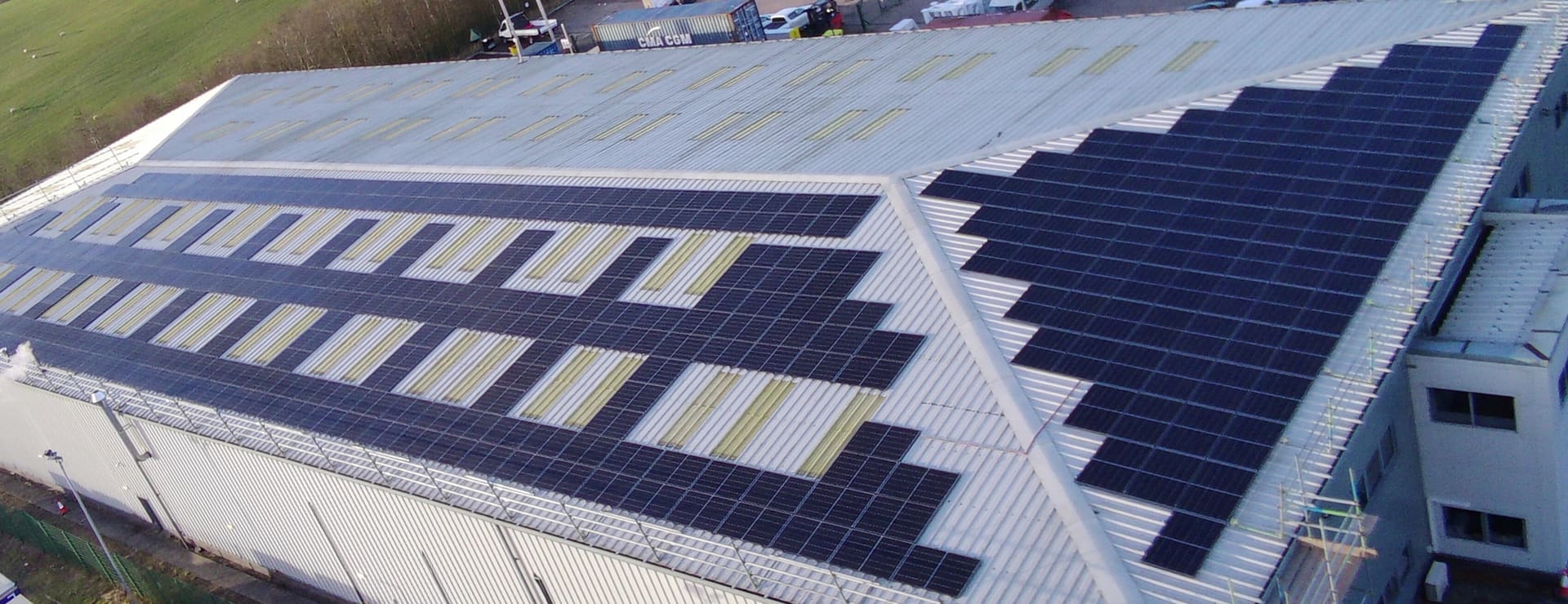
Many of our current commercial designs return their cost in around three years — then generate free power for decades.
Tier-one panels warranted for a quarter century, backed by MCS certification and independent auditing.
Fully funded installations that are cash-flow positive from day one — and can be structured to offset tax.
Bespoke design
Designed in CAD, around your roof and your load.
Our team has designed over 100 MW of solar. Every proposal includes a full CAD roof model, shading analysis and generation forecast matched to your half-hourly consumption, so the system you buy is the system that pays back fastest.
Delivery
What happens between signature and switch-on.
- Structural report on your roof
- DNO G99 application submitted
- Planning confirmed or applied for
- Site-specific RAMS before anyone climbs
- IPAF & PASMA-trained installers
- No subcontracted labour
- Independent audit of the install
- MCS certificate & O&M manual + as-builts
- Monitoring, servicing and a live app
Timings shown for a typical single-site rooftop system; multi-building programmes are phased. Your proposal carries the programme for your site.
Sectors
100 MW+ designed across sectors like yours.
What it costs
Commercial solar panels in Birmingham: the official cost per kW.
The Department for Energy Security and Net Zero records the total installed cost of every MCS-certified solar system by region and size. For the West Midlands in 2025/26 the mean was £1,628 per kW for 4 to 10 kW systems and £1,233 per kW for 10 to 50 kW, across 7,161 and 1,181 installations. Above 50 kW no band is published, because the jobs vary too much to average; cost per kW keeps falling with size.
Read those as a ceiling for a straightforward roof rather than a quote. Scaffolding or access, the structural report, the G99 application and commissioning cost about the same on 30 kWp as on 150 kWp, which is why the larger band is £400 per kW cheaper and why an array sized to the roof is usually the better buy. A profiled steel deck with simple access is the cheapest roof in the country to install on; a single-ply membrane needing ballasted mounting, or a frame needing strengthening, costs more. Our fixed price includes the structural survey and the grid application; ask whether anyone else's does.
What the system displaces is the other half of the sum: the average non-domestic price was 24.14p per kWh in the first quarter of 2026, including a Climate Change Levy that self-generated power avoids. The worked example in our guide to commercial solar cost in Birmingham runs a 100 kWp roof through it line by line.
West Midlands, 2025/26, with sources
- West Midlands mean installed cost in 2025/26: £1,628 per kW for 4 to 10 kW systems and £1,233 per kW for 10 to 50 kW, across 7,161 and 1,181 MCS-certified installations. Source: DESNZ, Solar PV cost data 2025/26, Regional costs (TIC)
- Average non-domestic electricity price in Q1 2026: 24.14p per kWh including the Climate Change Levy, which is £0.00801 per kWh from 1 April 2026 and is not charged on power you generate and use behind your own meter. Source: DESNZ, Quarterly energy prices table 3.4.2; gov.uk Climate Change Levy rates
- A south-facing 4 kWp array in Birmingham is modelled at 3,864 kWh a year, 966 kWh per kWp, so a 100 kWp roof generates roughly 96,600 kWh. Source: European Commission JRC, PVGIS 5.3, 4 kWp, south, 35 degrees, 14% loss
- Birmingham City Council declared a climate emergency in June 2019 and targets a net-zero carbon city by 2030; its Route to Zero programme puts industry at around 22% of the city's territorial emissions. Source: Birmingham City Council, Route to Zero (R20)
- Birmingham itself sits on National Grid Electricity Distribution's East Midlands licence area; the Black Country boroughs are on the West Midlands area. A G99 application is needed above 3.68 kW per phase and goes to the right team for your postcode. Source: Octopus Energy grid-supply-point API on real Birmingham postcodes; Energy Networks Association G98/G99
- Renewable generation and storage plant is left out of a building's rateable value in England from 1 April 2022 to 31 March 2035; the capital cost qualifies for the Annual Investment Allowance (100% to £1m) or the 50% first-year allowance, not full expensing. Source: S.I. 2022/405; gov.uk, full expensing and 50% first-year allowances
Where we install
Commercial solar across Birmingham, from five miles away.
Our base in Oldbury is five miles west of the city centre, so a Birmingham roof is local work rather than a day trip. We install on industrial estates, business parks, schools, warehouses and offices across Tyseley and the Environmental Enterprise District, Aston and Nechells, Erdington and the A38 corridor, Longbridge and Rubery, the Jewellery Quarter, the NEC, M42 and Birmingham Business Park, Digbeth and Bordesley, Kings Norton and Stirchley, Perry Barr and Great Barr and Hall Green and Acocks Green, and run dedicated pages for the surrounding towns.
Looking for panels on a house rather than a business? See solar panels for homes in Birmingham and our home solar and battery cost guide.
Before you commit
The questions finance directors actually ask.
- What payback should we expect? The real equation — cost per kWp, your import tariff, and why self-consumption matters more than sunshine.
- How do capital allowances work? Solar is special-rate plant, so full expensing does not apply. The routes that do — and what they are worth.
- Can we do it with no capital? Fully funded and PPA structures compared against a loan and outright purchase, trade-offs included.
- Do we need planning permission? Most commercial rooftop solar is permitted development. Where that stops, and what we submit for you.
Free survey
What the free Business Energy Survey covers.
A detailed analysis of your current energy expenditure and exactly how much a Commercial Solar PV system would save, delivered as a fully costed proposal, with zero obligation.
Book my free surveyQuestions
Straight answers.
Anything else. Call and speak to a director, not a sales team.
Is our roof suitable?
Most commercial roofs are, flat or pitched, steel or membrane. Our survey checks structure, orientation and shading, and the CAD design works around obstructions like plant, skylights and vents.
How is the system sized?
Against your half-hourly consumption data, not a rule of thumb. We size for maximum self-consumption first, power you use on-site is worth roughly three times what you'd earn exporting it.
What about tax and capital allowances?
Solar qualifies for capital allowances, and fully funded options can be structured to offset tax. Your proposal sets out the figures for your accountant to review.
Can we add battery storage later?
Yes. We design every system battery-ready. Adding storage later is straightforward, though installing both together usually gets the best combined price and payback.
How much do commercial solar panels cost in Birmingham?
On the official figures, the West Midlands mean in 2025/26 was £1,628 per kW for 4 to 10 kW systems and £1,233 per kW for 10 to 50 kW, so a 100 kWp rooftop array is roughly £123,000 as an average job and a well-suited steel-deck roof usually comes in below that. Cost per kW falls as systems grow because scaffolding, the structural report, the G99 application and commissioning are roughly fixed. We quote a single fixed price with the structural survey and the grid application included.
Which parts of Birmingham do you cover?
All of it, from our base in Oldbury five miles west of the centre: the industrial estates of Tyseley, Aston, Nechells and Erdington, the manufacturing belt around Longbridge, the Jewellery Quarter, Digbeth, Kings Norton and Perry Barr, and the business parks around the NEC and the M42. We also run dedicated pages for the Black Country boroughs, Solihull, Sutton Coldfield, Coventry and Bromsgrove.
Does a Birmingham business need planning permission for rooftop solar?
Usually not. Rooftop solar on commercial buildings in England is largely permitted development under Part 14 of the General Permitted Development Order, and the former 1 MW rooftop cap was removed in November 2023. Prior approval for siting and appearance can still apply, and listed buildings and conservation areas, of which Birmingham has many in the Jewellery Quarter and the city centre, are handled separately. We confirm the position for your building before quoting and submit anything that is needed.
Ready to see your roof's numbers?
Tell us the site and we'll analyse your half-hourly consumption, size the array to how you actually use power, and come back with a fully costed proposal. No obligation, and a director reviews every enquiry.
Get your free, no-obligation quote
Commercial solar, battery, EV or any electrical work — no pressure.
Ready to run the numbers?
Book your free Business Energy Survey, or call and speak to a director today.
Explore battery storage, EV charging and aftercare & monitoring.