
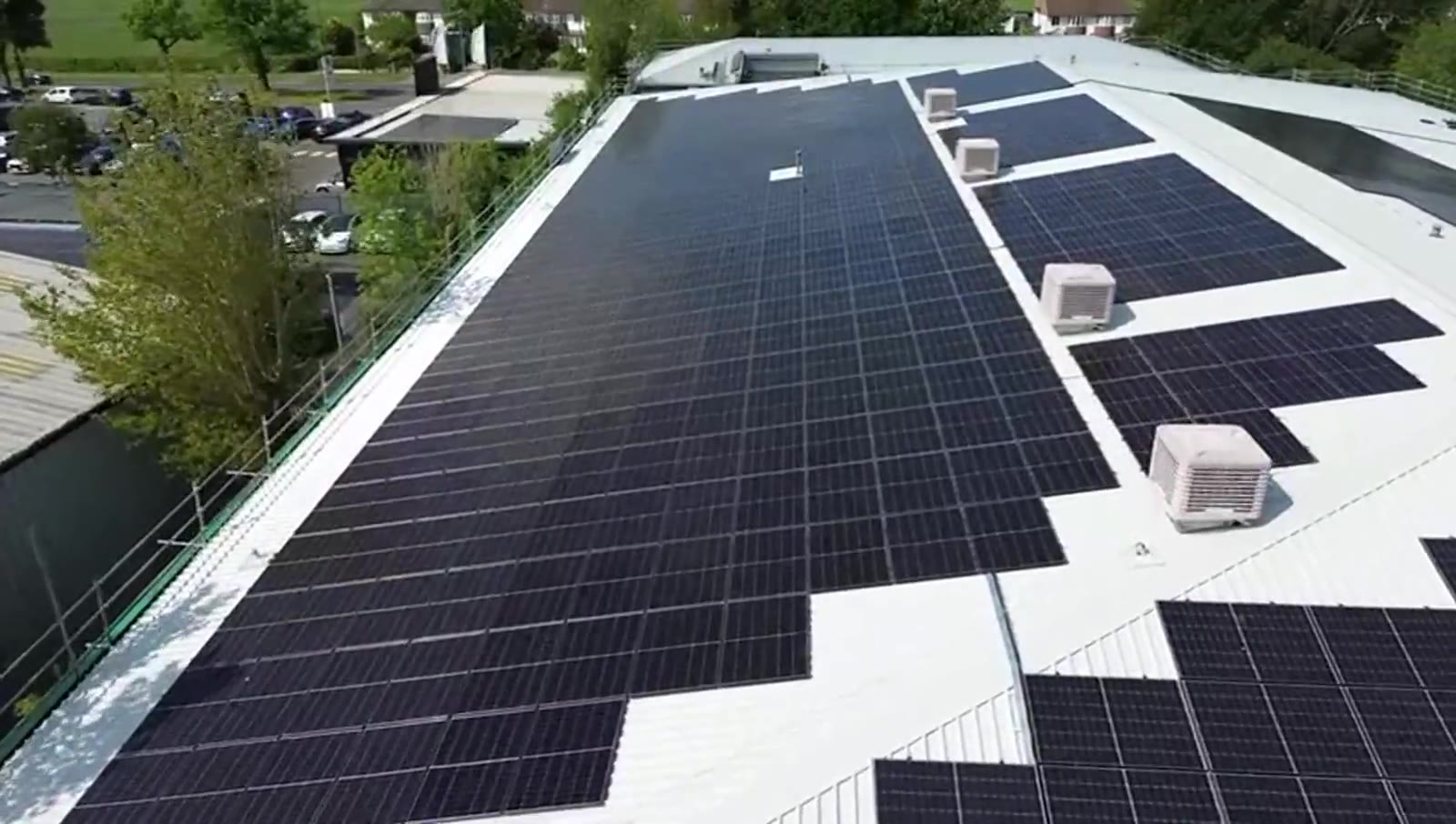
Commercial Solar · Manufacturing
Solar Panels for Factories & Manufacturing Sites
A factory's electricity bill behaves unlike almost any other commercial load. Compressors, extraction, chillers, CNC and moulding plant, conveyors, cranes and high-bay lighting draw a heavy, largely flat demand right across the working day, and that demand tracks your shift pattern rather than the weather. For most Midlands manufacturers, electricity has stopped being an overhead line and become a competitiveness issue, UK industrial power costs sit well above those of the European and North American plants you are quoted against, and unlike raw material prices there is a route to controlling part of it on your own site.
The same buildings that make that load expensive also make it fixable. Portal-frame production halls give large, uninterrupted, shallow-pitched roof planes sitting directly above the switchroom that feeds the plant, often several thousand square metres of usable roof over a single meter position. Because the generation curve of a south- or east/west-facing industrial roof lines up almost exactly with a 06:00–18:00 shift, the electricity is consumed metres from where it is produced, at your full delivered rate, without ever touching the distribution network. That coincidence of load and generation is why manufacturing has the strongest self-consumption case of any sector we work in.
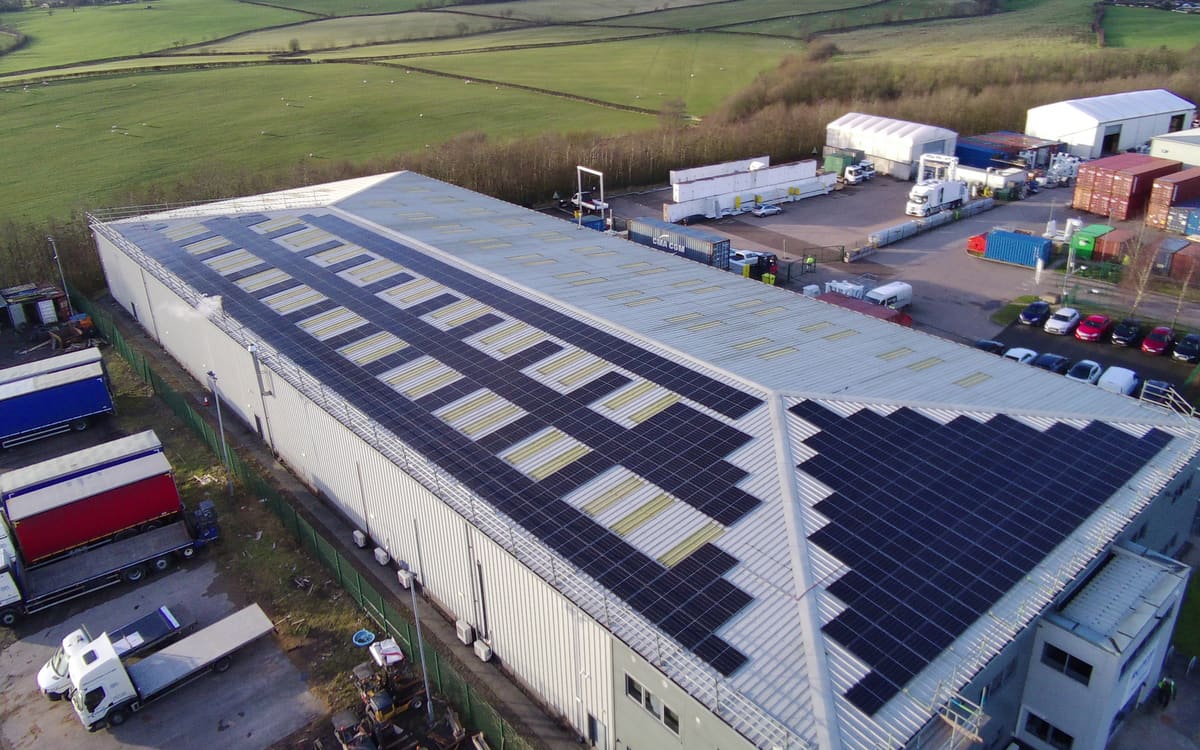
Green Tech Hub has designed and installed commercial PV from Oldbury since 2015, with over 100 MW designed across UK sites. We work the way manufacturing procurement expects: a half-hourly consumption survey before any array is proposed, in-house CAD roof design set out around your actual plant, extract, walkways and rooflight positions, and a director on the job from survey through to handover and independent audit. If you want a reference point on a live production site, our Rapiscan installation in Stoke is the closest, a genuinely complex industrial roof designed in CAD by our director before a single fixing was specified.
Factory load profiles are the strongest case for self-consumption we see, from the Tyseley units covered on our commercial solar panels Birmingham page to the metalworking estates on our commercial solar Walsall page.
Why solar works on manufacturing
Self-consumption is the entire economic argument, and factories are built for it. A unit you generate and use on site displaces a unit you would otherwise buy at your full delivered price: wholesale, network charges, policy levies and Climate Change Levy included. A unit you export earns only whatever your Smart Export Guarantee tariff pays, which is a fraction of that. A single-shift factory typically self-consumes 70–85% of a correctly sized array; a two-shift or 24/5 operation will often absorb 90% or more with no battery at all. That is the number that decides the business case, not the size of the roof.
For that reason we size from your half-hourly meter data, not from roof area. Twelve months of HH data shows the real base load, the shift-start step change, the summer chiller peak and the weekend baseline: and, critically, how much of a proposed array would actually be absorbed on a Saturday in June, which is the worst-case day for a factory. Most manufacturing sites already have a three-phase supply with an agreed capacity and power-factor arrangement, so the connection work is usually about the G99 application, export settings and protection settings rather than a new service. Where the profile shows meaningful evening or back-shift demand, battery storage can move midday surplus into those hours, but we only propose it where the data justifies it.
Industrial roofs are rarely the clean rectangles a desktop model assumes. Production roofs carry extract cowls, AHUs, condensers, rooflights, walkways, lightning protection and, on older buildings, north-light or saw-tooth geometry with limited usable orientation. Our CAD set-out works around all of it, keeps statutory access and maintenance corridors clear, and uses non-penetrative clamped rails on standing-seam and trapezoidal profiles so the sheet warranty is preserved. On a well-oriented West Midlands roof you should expect roughly 900–1,000 kWh per kWp per year, so a 500 kWp array on a production hall generates around 450,000–500,000 kWh annually, the large majority of it consumed on site.
Typical commercial payback runs at three to five years, with around three years common where daytime self-consumption is high. Beyond the bill, on-site generation has become a commercial requirement in its own right: Tier 1 customers, retailers and public-sector frameworks increasingly ask for Scope 2 emissions data, and a metered on-site array gives you an auditable figure rather than a supplier certificate. Where capital is the constraint, fully funded and PPA structures are available on installations above 100 kW. The same approach underpins our wider commercial solar work across Birmingham and the West Midlands.
What to weigh up first
The roof has to be worth 25 years. A PV array is a 25-year asset bolted to a sheet that may have ten years left, and solar does not fix a roof approaching the end of its life. It makes replacing it more expensive. Many West Midlands industrial units built between the 1970s and 1990s carry cement-fibre sheeting, and where a building predates 2000 there is a realistic chance of asbestos-containing materials, which brings the duty to manage under the Control of Asbestos Regulations 2012 into play before anyone accesses the roof. Structural capacity has to be checked properly too: purlin spacing, sheet condition and fixings assessed against wind and snow actions to BS EN 1991 and, on marginal buildings, signed off by a structural engineer rather than assumed by an installer. If the honest answer is 'reroof first, then solar', we will say so.
The DNO can change the scheme. Anything exporting above 16 A per phase, effectively every factory array, requires a G99 application approved by your Distribution Network Operator before it can be energised. That process takes weeks rather than days, and the offer can come back with an export limit, a requirement for additional protection, or a contribution towards network reinforcement. Parts of the Black Country and north Birmingham sit on constrained network sections. It is usually survivable, because a factory's value sits in self-consumption rather than export, but it can move both the programme and occasionally the sizing, and it belongs in the feasibility conversation rather than being discovered at commissioning.
Solar will not fix everything on your energy bill. December output on a UK roof is roughly an eighth of June output, so a winter night shift sees very little benefit without storage. PV produces electricity, so it does nothing for gas-fired process heat: ovens, kilns, dryers, steam, and if that is the bulk of your energy spend you should be sceptical of anyone selling rooftop PV as your decarbonisation answer. It also does not reliably reduce your agreed capacity (kVA) charge, because that is set by peak demand which can fall outside generating hours. And savings are only ever worth your contracted import rate: if you are locked into an unusually low fixed price for another two years, the early-year returns will be smaller than a headline model implies.
Disruption is manageable, but it is not zero. A factory install means roof access permits, MEWPs or scaffold, exclusion zones beneath the work area, and coordination with your production plan and any existing permit-to-work or hot-work systems. Roof work is genuinely hazardous: falls through fragile surfaces such as rooflights and cement sheets remain the single largest cause of roof-work fatalities in HSE data: so netting, safety decking and access planning are real cost lines, not optional extras, and a quote that omits them is not comparable. Production rarely has to stop, but the final DNO witness test and the tie-in to your switchgear normally need a short planned outage, best scheduled into a shutdown week.
Proof, not promises
Rapiscan Systems
Director-led CAD design maximising yield on a complex industrial roof, the first of three Rapiscan installations Green Tech Hub has delivered.
Read the full case studyThe numbers, sourced
Manufacturing solar in figures
Every figure below comes from a named public source, the same standard we hold our savings estimates to.
-
UK industrial electricity consumption fell 2.8% to 82.2 TWh in 2024, the lowest level since 1998, and accounted for 25.8% of all electricity consumed in the UK.
Source: DESNZ, Digest of UK Energy Statistics (DUKES) 2025, Chapter 5: Electricity
-
Make UK reports UK industrial electricity prices at around four times those in the United States and roughly 46% above the global average, and its 2025 Executive Survey found 71% of manufacturers expecting energy costs to rise.
Source: Make UK, 'Tackling Electricity Prices for Manufacturers' and Make UK 2025 Executive Survey
-
The 1 MW capacity cap on rooftop solar under permitted development for non-domestic buildings in England was removed with effect from 21 December 2023, so most factory rooftop arrays no longer need a planning application (siting conditions on roof edges and projection still apply).
Source: The Town and Country Planning (General Permitted Development etc.) (England) (Amendment) (No. 2) Order 2023, S.I. 2023/1279, legislation.gov.uk
-
Eligible on-site renewable generation and storage plant in England is 100% exempt from business rates from 1 April 2022 until 31 March 2035, applied by the Valuation Office Agency excluding it from rateable value, no application required.
Source: HM Treasury (Spring Statement 2022 green rates reliefs) / Valuation Office Agency
-
Solar PV is special rate plant for capital allowances, so it is excluded from full expensing. The available routes are the 50% special rate first-year allowance or the Annual Investment Allowance at 100% up to £1m a year.
Source: HMRC Capital Allowances Manual and GOV.UK 'Claim capital allowances'
-
The Climate Change Levy main rate on electricity is 0.801p per kWh from 1 April 2026. Renewable electricity generated and self-supplied on site is not subject to CCL, so every self-consumed solar unit avoids the levy as well as the commodity and network charge.
Source: GOV.UK Climate Change Levy rates; HMRC Excise Notice CCL1/3
-
Generation exporting above 16 A per phase: approximately 11.04 kW on a three-phase supply, and therefore virtually every commercial array, falls under Engineering Recommendation G99 and requires DNO approval before energisation, rather than the G98 connect-and-notify route.
Source: Energy Networks Association, Engineering Recommendation G99
-
Falls through fragile surfaces such as rooflights and asbestos-cement sheets are the largest single cause of roof-work deaths in the UK, and roof work accounts for around a quarter of construction fatalities.
Source: HSE, 'Fragile surfaces' guidance and HSG33 'Health and safety in roof work'
-
Elexon's Market-wide Half Hourly Settlement programme runs to completion in May 2027, moving the market to settlement on actual half-hourly data, making an accurate site load profile increasingly central to how energy is bought and how generation is valued.
Source: Elexon, Market-wide Half Hourly Settlement programme
-
Large UK companies (meeting two of: turnover over £36m, balance sheet over £18m, 250+ employees) must report UK energy use and Scope 1 and Scope 2 emissions in their Directors' Report under SECR, mandatory for financial years beginning on or after 1 April 2019.
Source: The Companies (Directors' Report) and Limited Liability Partnerships (Energy and Carbon Report) Regulations 2018; GOV.UK SECR guidance
Data last reviewed: July 2026
The next step
If you run a manufacturing site in Birmingham, the Black Country or the wider West Midlands, the quickest route to a real answer is our free Business Energy Survey. We take twelve months of your half-hourly meter data, survey the roof properly: structure, sheet condition, plant, access and rooflights included, and come back with a CAD set-out, a modelled self-consumption figure and a payback you can put in front of a board. That includes an honest view if the roof, the network or your current supply contract makes this the wrong year to do it. Call Green Tech Hub on 0121 661 6400 or request a survey, and we will arrange a site visit with the director who would run the job.
Manufacturing solar questions
How much of our factory's electricity can rooftop solar realistically supply?
It depends entirely on the ratio of usable roof to consumption. A typical single-shift factory with a reasonable roof covers around 20-40% of annual electricity consumption. Energy-dense operations with small roofs relative to load - foundries, plating lines, plastics processing, cold stores - may only reach 10-15%. That is not a reason to walk away: the number that drives payback is what proportion of the array's output you self-consume, and on a manufacturing site that should be above 85%. A smaller array with 95% self-consumption pays back faster than a bigger one exporting half its output.
Do we need a G99 application, and how long does it take?
Yes. Anything exporting above 16 A per phase falls under Engineering Recommendation G99, which on a three-phase supply is roughly 11 kW - so every factory-scale array. The DNO must approve the connection before the system can be energised. Expect weeks rather than days, and expect the offer to specify protection settings and possibly an export limit. We prepare and submit the application, handle the technical correspondence and arrange witness testing. If your site sits on a constrained part of the network, an export limitation device usually resolves it with little effect on a self-consumption-led scheme.
Our production roof is 1990s profiled steel with rooflights and a lot of extract plant. Is it viable?
Usually yes, and this is exactly the situation the Rapiscan Stoke job dealt with. The work is in the design: we survey the roof, model the obstructions, and produce a CAD set-out that works around cowls, AHUs, condensers, walkways and rooflights while keeping access and maintenance routes clear. Two things must be checked first though. The sheet needs enough remaining service life to justify a 25-year array on top of it, and where the building predates 2000 an asbestos survey and the duty-to-manage position under the Control of Asbestos Regulations 2012 must be settled before roof access. If the roof needs replacing, that has to be dealt with first.
We run a night shift. Is battery storage worth adding?
Sometimes, but the half-hourly data decides it, not a rule of thumb. If your daytime load already absorbs nearly all of the array's output, a battery has little surplus to store and the numbers rarely work. If the profile shows a genuine midday export surplus plus a substantial evening or back-shift load, storage can shift that energy into hours you would otherwise import, and can also support peak-shaving. We model both cases from your actual data and will tell you if storage does not earn its place in the scheme.
Will this help with customer ESG and Scope 2 reporting?
Yes, and for many manufacturers it is now as important as the bill saving. On-site generation directly reduces purchased electricity, which reduces reported Scope 2 emissions under both location-based and market-based accounting. Large companies already report this under SECR, and increasingly it is Tier 1 customers, retailers and public-sector frameworks driving the question down the supply chain. A metered on-site array produces generation data you can evidence and audit, which is a stronger position in a customer questionnaire than a purchased green tariff certificate alone.
What is the tax treatment for a limited company, and can it be funded?
Solar PV is treated as special rate plant, which means it is excluded from full expensing - be wary of any supplier claiming otherwise. The two realistic routes are the Annual Investment Allowance, which gives 100% relief up to £1m a year, or the 50% special rate first-year allowance. Separately, eligible on-site generation and storage is exempt from business rates in England to 31 March 2035. Note that the domestic zero rate of VAT does not apply to commercial premises. Confirm the position with your accountant. If capital expenditure is the obstacle, fully funded and PPA options are available on installations above 100 kW.
Other sectors we serve
-
Agricultural & Farm Buildings
Grain stores, dairies and workshops under big steel-portal roofs, often on constrained rural grids.
-
Poultry Farms
Ventilation, heating and lighting run right through daylight, exceptional self-consumption.
-
Offices & Business Parks
A weekday nine-to-five load that matches generation almost hour for hour.
Get the numbers for your manufacturing site
Get your free, no-obligation quote
Commercial solar, battery, EV or any electrical work — no pressure.