
Commercial Solar · Community Buildings
Solar Panels for Community Buildings & Places of Worship
Community buildings do not have a normal load curve, and that is the whole problem. A gurdwara, mosque, church hall, community centre or village hall runs seven days a week on an irregular rhythm: a langar kitchen going all day, a Sunday morning service, a Tuesday lunch club, a Friday night youth session, a Saturday wedding, a food bank, a warm space, a nursery in the weekday mornings. Demand is peaky, evening-heavy and does not sit neatly inside the 9-to-5 window that most commercial solar modelling assumes. Meanwhile the electricity bill is paid from donations, hire income and restricted grants rather than trading profit, so every pound on the meter is a pound not spent on the people the building exists to serve.
These buildings do suit solar, for reasons that are specific to them. Ownership horizons are extraordinarily long, nobody sells a parish church or a gurdwara in five years, so a 25-year generating asset genuinely matches the tenure, which is rarely true of a leasehold industrial unit. Many are also much better roofs than people assume: post-war and modern community centres, halls, mosques and gurdwaras typically have large, simple, uncluttered pitched roofs with no rooftop plant, no rooflights and no shading. And a growing number now carry real daytime demand from catering, extraction, hall lighting and cooling that solar can serve directly.
Green Tech Hub has designed and installed on exactly this kind of site. Our GNG Gurdwara project paired rooftop PV with battery storage specifically because the building ran a busy seven-day usage profile that a solar-only scheme would have wasted, and our work with the Clifton Diocese covered a multi-site estate delivered as a staged rollout across buildings of very different ages and consent positions. Both are in our case studies. Every scheme starts with a half-hourly consumption survey and director-led CAD roof design, because on this sector guesswork produces the wrong system almost every time.
Community buildings sit in every borough we cover; the city-wide picture, including costs per kW and planning, is on our commercial solar Birmingham page, with the wider region on commercial solar West Midlands.
Why solar works on community buildings
The economics of a community building turn entirely on when the building is actually in use, and that is why half-hourly data matters here more than in any other sector we work in. Taking an annual kWh figure off the bill and dividing by twelve is worthless on a site whose consumption is event-driven. Two buildings with identical annual usage can need completely different systems: one with a commercial kitchen, extraction and cooling running from mid-morning to late afternoon every day will self-consume the great majority of what a rooftop array produces, while a hall used for three evening sessions a week will export most of it. We pull the half-hourly data from the supply before we size anything, then design to the profile we can see rather than the profile we would like.
On a well-oriented West Midlands roof you should expect roughly 900 to 1,000 kWh per kWp per year. What that generation is worth depends almost entirely on self-consumption: a unit you use on site displaces the full import price including standing charges and levies, while a unit exported under the Smart Export Guarantee earns a fraction of that. For community buildings the gap between those two numbers is usually the difference between a good investment and a mediocre one, which is why battery storage is a more central part of the design here than it is for a warehouse or a factory. A correctly sized battery moves midday generation into the evening and weekend event windows when the building is full, the lights and heating are on and the kitchen is running. That is precisely the reasoning behind the PV-plus-battery specification at GNG Gurdwara.
The tax and rates position is also genuinely different, and it is routinely got wrong. If your building is run by a charity that pays no corporation tax, capital allowances are worth nothing to you, the 50% special-rate first-year allowance and the £1m Annual Investment Allowance only help an entity with a tax bill to reduce, and solar is special-rate plant so it is excluded from full expensing in any case. The lever that actually matters to a charity is VAT. Since February 2024 the zero rate for energy-saving materials extends to installations in buildings used solely for a relevant charitable purpose, which can take 20% off the whole installed cost, more than any allowance a taxpaying business could claim. On top of that, onsite renewable generation and storage is exempt from business rates in England until 31 March 2035, and charities already receive up to 80% charitable rate relief. We set out the practical funding routes, including fully funded and PPA structures, though those are only available on installs above 100kW.
Roof characteristics split this sector in two. A 1970s-to-2000s community hall, gurdwara or mosque is often an easier roof than an industrial shed: simple geometry, generous south-facing pitch, straightforward internal access to the purlins and no rooftop plant to design around. A medieval or Victorian church is a different exercise entirely, with unknown timber condition, lead or natural slate coverings, steeply pitched nave and aisle roofs and heavy heritage constraints. Multi-building sites, which is what most parishes, dioceses and community trusts actually are, benefit most from being surveyed as an estate rather than one building at a time: the hall roof frequently carries the array that serves the whole site far better than the sanctuary roof ever could, and a staged rollout lets you fund the easy buildings first and learn from them before touching the difficult ones.
What to weigh up first
Consent is the single biggest programme risk, and it is slower than clients expect. For a Church of England building, the Faculty Jurisdiction (Amendment) Rules 2022 added photovoltaic panels to List B, but only on a church that is neither listed nor in a conservation area, which is a much smaller set of buildings than it sounds. With around 12,500 of the Church of England's roughly 16,000 churches listed, most parishes will need a full faculty with DAC advice, not a quick archdeacon's approval. The ecclesiastical exemption from listed building consent covers only six denominations, so a listed gurdwara, mosque, synagogue, Pentecostal or independent church gets no such route and must apply for ordinary listed building consent from the local planning authority. Historic England's position on principal and highly visible roof slopes, particularly on Grade I and II* buildings, is restrictive. On some heritage buildings the honest answer is that the church roof is the wrong roof, and on a minority of sites there is no viable scheme at all. We will tell you that at survey stage rather than after you have paid for a heritage statement.
Structure, wildlife and access add cost that does not appear on a standard commercial quote. Older buildings often have no reliable structural record, so the quinquennial inspection report and, frequently, a structural engineer's opinion are needed before load can be signed off. Scaffolding to a tall nave or a slate roof with restricted vehicle access can cost more than the panels themselves. Bats are a genuine constraint, not a formality: all UK bat species and their roosts are legally protected, roof voids in older community buildings and churches commonly hold them, and works affecting a roost require a licence from Natural England. Summer maternity colonies mean the survey and works window is often restricted during exactly the months you would want to be on the roof, so a realistic programme allows for an ecology survey and a possible seasonal delay.
Be clear-eyed about seasonality, because this sector has the worst possible mismatch. December output is roughly a tenth of June output, while a church or community building typically consumes most electricity in winter: Christmas services, dark afternoons, heating and lighting all running at once. If you are also replacing gas heating with electric radiant panels or heat pumps as part of a net zero commitment, solar will not cover that additional winter load. It will reduce your annual bill; it will not decarbonise winter heating on its own, and anyone telling you otherwise is selling. Payback tracks the load profile honestly: a building with real seven-day daytime demand can land in the same three-to-five year range as a commercial site, whereas a hall used two evenings a week will take considerably longer even with storage.
Finally, governance and VAT small print. Decisions here sit with volunteer trustees, a PCC or a management committee that may meet quarterly, often alongside congregational consultation and funder approval, so a realistic decision cycle is six to eighteen months rather than six weeks, build that into any grant deadline. The VAT zero rate depends on the building being used solely, in practice at least 95%, for non-business charitable purposes; a hall with substantial commercial lettings, a paid nursery tenancy or a bar can fail that test or qualify only in part, so get the position confirmed in writing before you budget on the basis of 20% off. And installation must be programmed around services, festivals, funerals and weddings, which are not moveable. That means shorter working days, more visits and a longer overall programme than the same array on an empty warehouse.
Proof, not promises
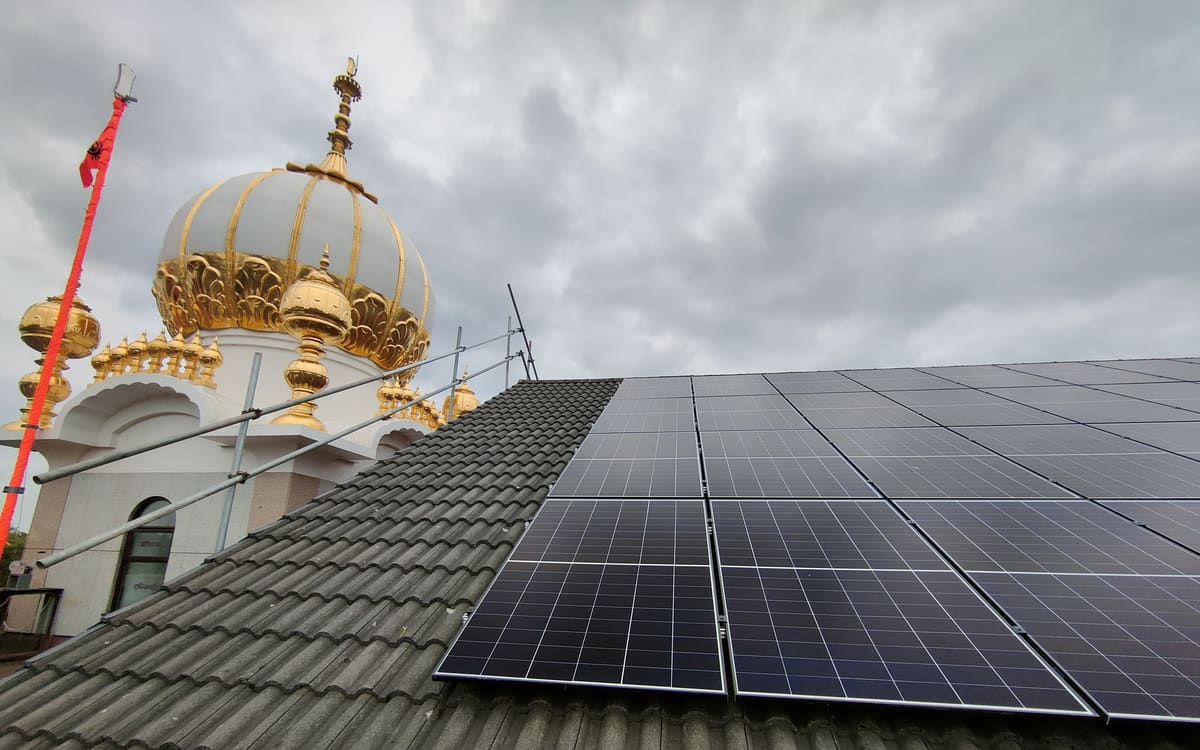
Guru Nanak Gurdwara
Solar plus battery storage cutting running costs for a busy seven-day community site in Smethwick, with storage smoothing the evening and weekend load.
Read the full case studyThe numbers, sourced
Community Buildings solar in figures
Every figure below comes from a named public source, the same standard we hold our savings estimates to.
-
The Church of England cares for around 16,000 church buildings and 42 cathedrals, of which about 12,500 are listed, including roughly 45% of all England's Grade I listed buildings. Heritage designation, not roof pitch, is the main constraint on solar across this estate.
Source: The Church of England
-
The Faculty Jurisdiction (Amendment) Rules 2022 (SI 2022/155) added to List B: 'The installation of photovoltaic panels on a church which is not a listed building or in a conservation area' (matter B1(20)), with an equivalent provision for church halls, allowing archdeacon's approval instead of a full faculty for those buildings only.
Source: legislation.gov.uk, SI 2022/155
-
The Ecclesiastical Exemption (Listed Buildings and Conservation Areas) (England) Order 2010 covers only six denominations: the Church of England, the Church in Wales, the Roman Catholic Church, the Methodist Church, the Baptist Union of Great Britain and the United Reformed Church. Listed gurdwaras, mosques, synagogues and independent churches must obtain ordinary listed building consent from the local planning authority.
Source: legislation.gov.uk (SI 2010/1176) and Historic England
-
From 1 February 2024 the VAT zero rate for the installation of energy-saving materials, including solar panels, was extended to buildings used solely for a relevant charitable purpose: covering many village halls, church halls, community centres and places of worship. The zero rate does not apply to ordinary commercial premises.
Source: HMRC VAT Notice 708/6
-
The Listed Places of Worship Grant Scheme has closed and been replaced by the Places of Worship Renewal Fund: £92 million over four years (about £23 million a year), DCMS-funded and delivered by Historic England, with grants from £10,000 up to £1 million for capital works at active listed places of worship of any faith or denomination in England.
Source: Historic England / DCMS
-
Eligible onsite renewable generation and storage, including rooftop solar for self-consumption and battery storage, is exempt from business rates in England from 1 April 2022 to 31 March 2035. Charities separately receive up to 80% charitable rate relief, with councils able to add discretionary relief on top.
Source: HM Treasury (Spring Statement 2022 green business rates reliefs) and GOV.UK business rates relief guidance
-
There are over 10,000 village halls and similar rural community buildings in England, 88% of them registered charities and almost entirely volunteer-managed, with an estimated 80,000 people volunteering regularly to keep them running. Governance capacity, not capital, is often the binding constraint on energy projects.
Source: ACRE (Action with Communities in Rural England)
-
All UK bat species and their roosts are legally protected, and roof voids in older community buildings and churches commonly hold roosts, summer maternity colonies can number several hundred bats. Works that may affect a roost require a licence from Natural England, which is free but must be programmed for.
Source: Bat Conservation Trust and Natural England (Bats in Churches partnership)
-
The Church of England's General Synod set a net zero carbon target of 2030 in February 2020, with the Routemap to Net Zero Carbon approved by Synod in July 2022, placing formal decarbonisation expectations on parishes, dioceses and cathedrals.
Source: The Church of England
Data last reviewed: July 2026
The next step
If you are a trustee, warden, committee member or facilities lead at a community building or place of worship in Birmingham or the wider West Midlands, start with a free Business Energy Survey. We pull and analyse your half-hourly consumption data, assess the roof properly with in-house CAD design, give you a straight view on the consent route your building actually faces: faculty, denominational consent, listed building consent or permitted development, and model the numbers with and without battery storage so you can see what self-consumption is genuinely worth on your usage pattern. If the answer is that your building is not a good candidate, we will tell you that too. Green Tech Hub Ltd is MCS-certified (NIC-600049), RECC registered (00067281) and NICEIC approved, has designed over 100 MW of commercial solar since 2015, and holds a 5.0 rating from 44 Google reviews. Call 0121 661 6400 or request your survey — no cost, no obligation, and we are used to working to a committee's timetable rather than a sales one.
Community Buildings solar questions
Do we need a faculty to install solar panels on our church?
If your church is Church of England and is neither listed nor in a conservation area, photovoltaic panels are now a List B matter under the Faculty Jurisdiction (Amendment) Rules 2022, which means written approval from the archdeacon rather than a full faculty. If the building is listed or sits in a conservation area: which applies to the majority of Church of England churches, as around 12,500 of roughly 16,000 are listed. You will need a full faculty, with advice from your Diocesan Advisory Committee. Start that conversation with the DAC and your quinquennial architect before you commission a design, because their view on which roof slopes are acceptable will shape the whole scheme.
Our building is listed but we are not Church of England. What consent do we need?
The ecclesiastical exemption from listed building consent applies to only six denominations: the Church of England, the Church in Wales, the Roman Catholic Church, the Methodist Church, the Baptist Union of Great Britain and the United Reformed Church. A listed gurdwara, mosque, synagogue, Pentecostal church or independent chapel is not covered and must apply for listed building consent from the local planning authority in the normal way, alongside planning permission where the visual impact requires it. In practice this is often a longer route than the faculty system, so allow for it in your programme.
Will we pay VAT on a solar installation for our community building?
Possibly not. Since 1 February 2024 the zero rate for energy-saving materials applies to installations in buildings used solely for a relevant charitable purpose, which can include village halls, church halls, community centres and places of worship. The test is that the building is used otherwise than in the course of business, with an extra-statutory allowance for up to 5% business use. A hall with significant commercial lettings, a paid nursery tenancy or a bar may fail that test or qualify only in part. Get your position confirmed in writing before you budget on the basis of zero-rating, because the difference is 20% of the project cost. The domestic zero rate does not apply to ordinary commercial premises, so this is a relief specific to charitable buildings.
Is solar worth it if the building is mainly used in the evenings and at weekends?
It can be, but only with storage and only with honest modelling. Solar generates in the middle of the day, so a building whose demand sits between 5pm and 10pm will export most of its generation and earn only the Smart Export Guarantee rate, which is worth far less than a unit you use yourself. A correctly sized battery shifts that midday generation into the evening and weekend event windows, which is why we specified PV with battery storage at GNG Gurdwara rather than solar alone. The first thing we do is pull the half-hourly data from your supply, because on this sector an annual consumption figure tells you almost nothing useful about what size system you need.
Will solar panels heat our building in winter?
No, and you should be wary of anyone who implies otherwise. December output from a rooftop array is roughly a tenth of June output, while most community buildings and churches consume the most electricity in winter. If you are moving from gas to electric radiant heating or heat pumps as part of a net zero commitment, solar will offset part of your annual electricity cost but will not cover that winter heating load. Treat PV as a bill-reduction and self-consumption measure, and treat heating decarbonisation as a separate project with its own business case.
How do we fund a scheme if we have no capital reserves?
Most community buildings use a combination of restricted funds, congregational or community appeals, and grant funding. The Places of Worship Renewal Fund, delivered by Historic England with £92 million over four years, is now the main national route for listed places of worship in England, though it is competitive and aimed at capital works at buildings in greatest need. Fully funded and power purchase agreement structures are available from us, but only on installations above 100kW, which rules out most single church or hall schemes in the 10 to 50 kWp range. For multi-site estates such as a diocese or a community trust, a staged rollout part-funded from the savings of earlier phases is usually more realistic than trying to finance everything at once.
How long does the whole process take from first enquiry to switch-on?
Longer than a commercial site, and the delay is rarely technical. Decisions sit with volunteer trustees, a PCC or a management committee that may only meet quarterly, often alongside congregational consultation and funder approval, so six to eighteen months from first conversation to order is normal. Consent adds to that: a full faculty or a listed building consent application typically runs to several months. An ecology survey for bats can impose a seasonal constraint on top. The installation itself is usually the shortest part, though it has to be programmed around services, festivals, weddings and funerals, which means shorter working days and more visits than the same array on an empty warehouse.
Other sectors we serve
-
Schools & Education
Term-time weekday load, holiday surplus, and a live feed the curriculum can use.
-
Warehouses & Logistics
Large unshaded roof spans and daytime machinery load, the fastest payback in commercial solar.
-
Manufacturing & Factories
Heavy, steady daytime process load means the highest self-consumption of any sector.
Get the numbers for your community buildings site
Get your free, no-obligation quote
Commercial solar, battery, EV or any electrical work — no pressure.