
Commercial Solar · Schools
Solar Panels for Schools & Academy Trusts
Electricity is one of the largest costs in a school budget that nobody chose and nobody can cap. Lighting, ICT suites and server rooms, catering kitchens, sports hall and hall lighting, and increasingly heat pumps and staff EV chargers all draw hardest between roughly 7am and 4pm on a weekday, precisely the hours a rooftop array is generating. Education is the single largest source of carbon emissions from public sector buildings in England, and every pound spent on imported electricity is a pound not spent on teaching.
School estates are unusually well suited to rooftop PV. Most are low-rise, one or two storeys, with wide uninterrupted roof planes, generous separation from neighbouring buildings, minimal overshading beyond their own trees and plant, and no commercial landlord to negotiate with. A typical primary can carry 30–100 kWp across its hall and teaching block roofs; a secondary with sports hall, dining hall and multiple teaching blocks routinely supports 150–500 kWp. Across Birmingham and the wider West Midlands, a well-oriented, unshaded roof yields in the region of 900–1,000 kWh per kWp each year.
But a school is not a factory, and designing one as if it were is the most common and most expensive mistake in this sector. Pupils are on site for a statutory minimum of 190 days a year, and the building is closed for most of August, when the array is producing its best output of the entire year. The design question is therefore not “how many panels fit on the roof” but “how much of this generation can the school actually use, and what happens to the rest”.
Schools across the conurbation are surveyed from our Oldbury base; the regional cost figures and the areas we cover are on the commercial solar Birmingham page.
Why solar works on schools
The term-time load profile is close to ideal for solar. Demand ramps from around 6.30–7am as the kitchen, boiler plant and cleaning come on, plateaus through the teaching day as lighting, ICT and catering run together, and falls away sharply after 4–5pm apart from evening lettings and clubs. That plateau sits squarely under the generation curve for roughly 39 weeks of the year. An array sized to term-time daytime demand rather than to available roof area will self-consume the large majority of what it produces while the school is open, which is the outcome that actually matters.
It matters because a self-consumed unit and an exported unit are not worth the same money. When the school uses its own generation it avoids the full delivered cost of imported electricity, commodity price plus network charges, policy costs and levies. When it exports, it earns a Smart Export Guarantee rate linked to wholesale prices, which is materially lower. The economics of school solar reward correct sizing and load-matching, not maximum installed capacity. We start every school design from twelve months of half-hourly consumption data mapped against the school’s own term calendar, so the array is sized to the demand that genuinely exists in October and February, not to a headline kWp figure.
Storage has a real but specific role here, and it is worth being precise about it. A battery shifts energy within a day. It will not store July for September. What it does well is cover the early-morning kitchen and lighting peak before generation ramps, ride through cloud transients, extend cover into dark winter afternoons, and smooth the residual holiday load from servers, security systems, frost protection and site staff. Battery storage is worth modelling on a school site; seasonal surplus, by contrast, is an export and sizing question rather than a storage one.
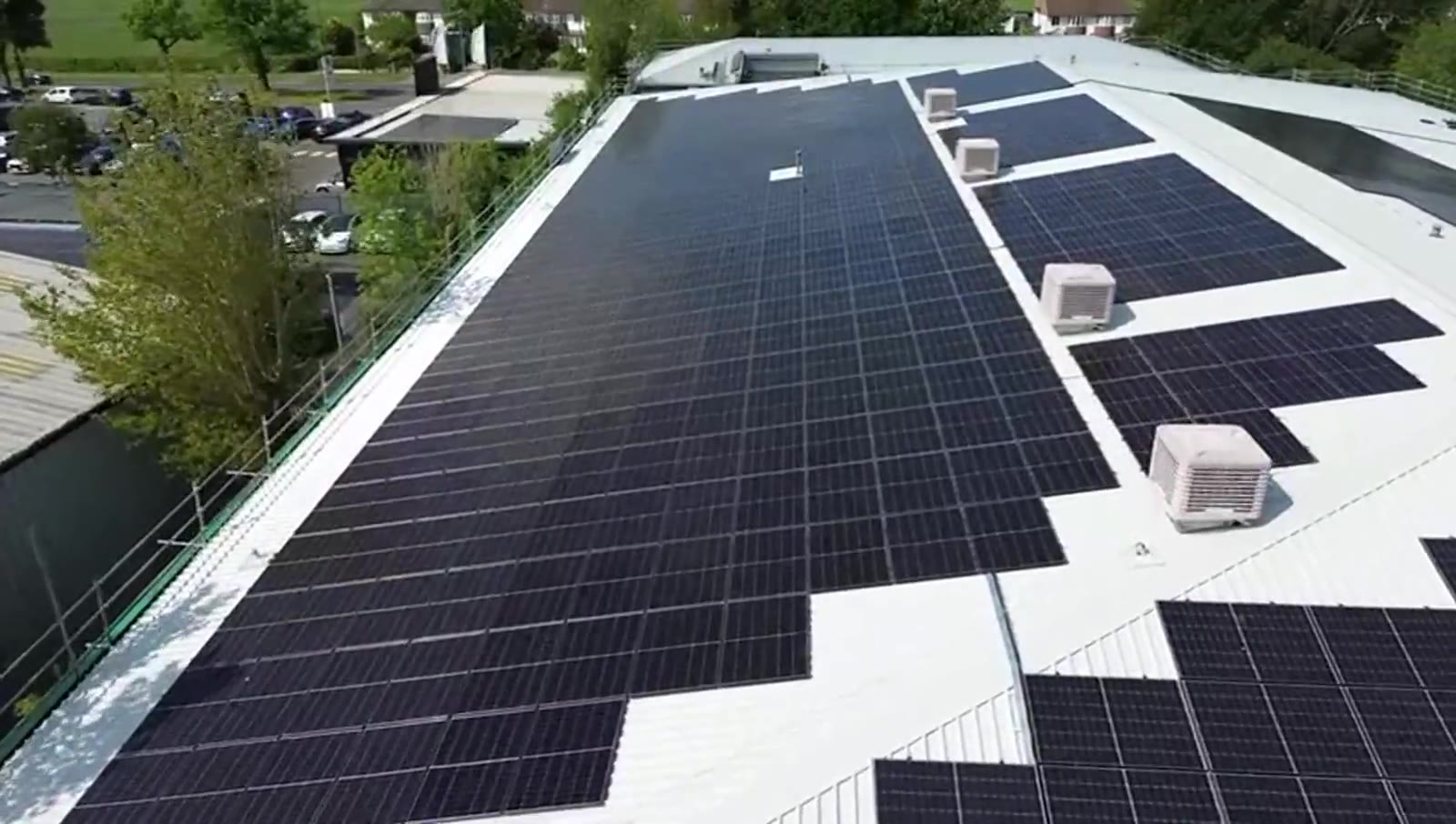
Roofs across a school estate rarely match. Post-war and 1960s–70s system-built blocks tend to have flat felt or single-ply decks, which suit ballasted, non-penetrative mounting once wind uplift and residual roof life have been checked. Victorian and Edwardian board schools bring steep pitched slate or tile, limited plant space and frequent heritage constraints. Modular and temporary classroom blocks are usually excluded outright on structural and life-expectancy grounds. Every roof plane is modelled individually in-house in CAD before a price is issued. For multi-academy trusts and diocesan estates the same logic applies across sites: our Clifton Diocese work followed a staged rollout: survey the whole estate, rank sites by roof condition and self-consumption potential, then install in phases as funding and holiday windows allow, rather than committing the entire estate on one set of assumptions.
What to weigh up first
The summer holiday is this sector’s genuine weakness and no honest installer should skate over it. Six weeks of the highest-yielding period in the year fall when the building is close to empty. If the array has been sized to fill the roof rather than to meet term-time load, a significant share of annual generation will be exported at a rate well below what the school pays to import, and the payback model quietly stretches. Sizing to load, being realistic about export value, and checking whether the school runs summer schools, holiday clubs or lettings all change the answer. Any proposal showing a school consuming most of its own output in August is not modelling your school.
Asbestos and structure are the two things most likely to change the cost after survey. Any school building constructed or refurbished before 2000 must be presumed to contain asbestos until proven otherwise, and the DfE’s own assurance survey found asbestos present in around four in five schools that responded. Roof fixings, plant room penetrations, cable routes through ceiling voids and riser works all have the potential to disturb asbestos-containing materials, which means reviewing the asbestos register and, where necessary, commissioning a refurbishment and demolition survey and licensed removal, with real cost and programme consequences. Separately, system-built blocks from the 1960s and 70s frequently have lightweight decks and incomplete as-built records; a structural engineer’s sign-off on imposed load is not a formality, and some blocks simply will not take a ballasted array without strengthening.
Consent and procurement take longer in education than in any other sector we work in. Local-authority maintained schools need the LA’s agreement as freeholder; voluntary-aided and foundation schools involve trustees and, often, a diocesan board. Academy trusts must follow their funding agreement and DfE land transactions guidance: and where a scheme is third-party funded through a rooftop lease and power purchase agreement, granting that lease generally requires Secretary of State consent via the DfE’s land transaction forms, a process measured in months rather than weeks. Grant routes have their own calendars: the Condition Improvement Fund runs an annual bidding round with restricted eligibility, and Salix’s Public Sector Decarbonisation Scheme opens in defined phases with fixed delivery deadlines. In practice, a scheme installed in one summer holiday usually needs a decision the previous autumn.
Delivery has to bend to the school, not the other way around. Realistically that means most work is programmed into the Easter or summer holidays, with any term-time activity requiring DBS-checked operatives, site induction with the safeguarding lead, hard segregation of the works area, deliveries scheduled away from pupil movement and drop-off times, and agreement on scaffold, crane positions, roof access and the fire strategy with the site manager. Compressing a whole install into a six-week window is achievable but leaves no slack for weather or a late asbestos finding. On tax, be aware that the capital allowance routes available to trading companies, the 50% special-rate first-year allowance or the Annual Investment Allowance, are of no benefit to a non-taxpaying academy trust or maintained school, and the domestic zero rate of VAT for energy-saving materials does not apply to school premises. Those reliefs are only relevant to independent schools operating as taxable entities, and your finance lead should confirm the position before they appear in any business case.
Proof, not promises
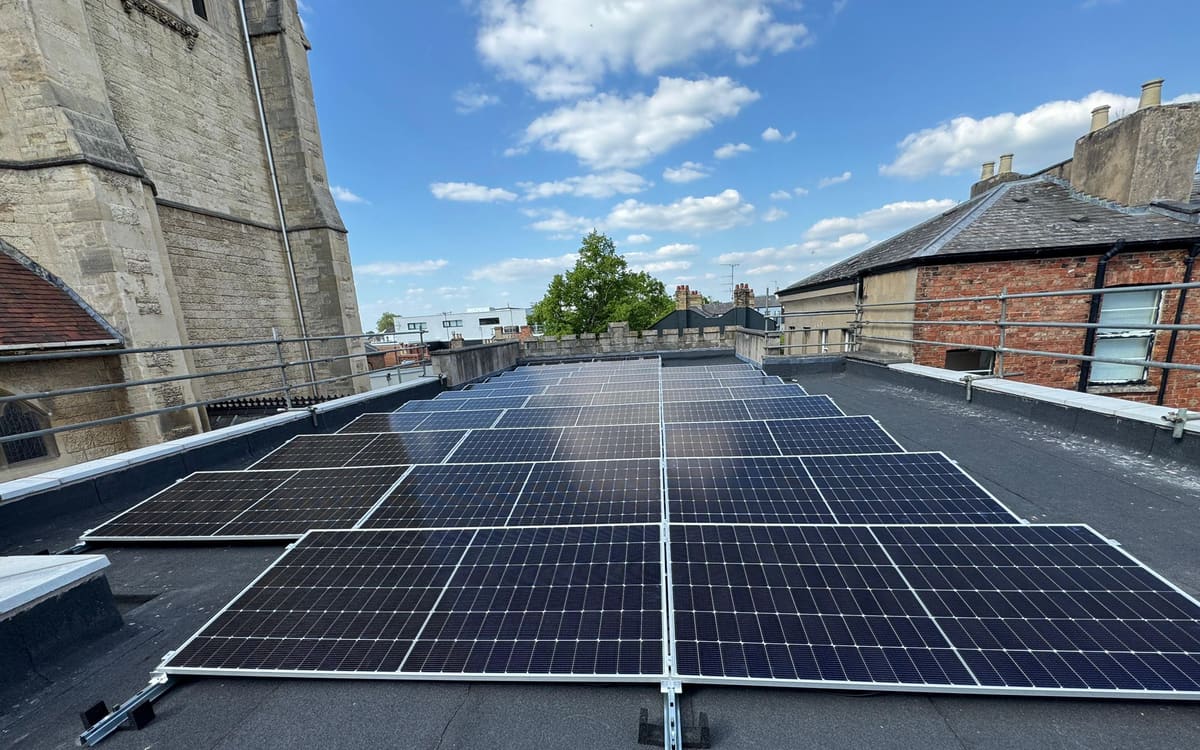
Church of St Gregory the Great
Part of the Clifton Diocese programme: a 15.95 kWp array on a Cheltenham church, delivered with the care a heritage-adjacent building demands.
Read the full case studyThe numbers, sourced
Schools solar in figures
Every figure below comes from a named public source, the same standard we hold our savings estimates to.
-
Education is the largest emitting part of the public sector building estate in England, accounting for 37% of public sector building emissions, 13% from state primary schools, 11% from state secondary schools and 13% from universities.
Source: National Audit Office, 'Department for Education: sustainability overview' (28 June 2023)
-
The DfE oversees around 21,600 maintained schools in England: more than 11,400 run by local authorities and more than 10,200 academies within single or multi-academy trusts, so ownership, consent and procurement routes differ significantly from site to site.
Source: National Audit Office, 'Department for Education: sustainability overview' (2023)
-
The DfE's Asbestos Management Assurance Process surveyed 22,072 state-funded schools in England; 88.4% responded and 80.9% of participating schools reported some asbestos present on site.
Source: Department for Education, Asbestos Management Assurance Process (AMAP) report, July 2019
-
Schools in England must open for at least 380 half-day sessions: 190 days: each school year, so a school building is fully occupied for roughly 39 weeks and closed for around 13, including most of the highest-generating summer weeks.
Source: The Education (School Day and School Year) (England) Regulations 1999 (SI 1999/3181), legislation.gov.uk
-
The Condition Improvement Fund made over £450 million available for the 2026 to 2027 round, with outcomes announced on 22 May 2026 covering 813 projects at 684 establishments. Eligibility is limited to standalone academies, sixth-form colleges, voluntary-aided schools and MATs with fewer than five schools or fewer than 3,000 pupils.
Source: GOV.UK, 'Condition Improvement Fund: 2026 to 2027 outcome' (Department for Education)
-
Great British Energy's schools solar programme committed around £80 million to roughly 200 schools; 100 schools and colleges had completed installations as at 5 March 2026, with around 250 expected by summer 2026, targeted at clusters of deprivation in the North East, West Midlands and North West.
Source: Great British Energy, gbe.gov.uk (5 March 2026)
-
The Public Sector Decarbonisation Scheme, delivered by Salix for DESNZ, closed to new applications in November 2024 after Phase 4, which DESNZ describes as the final phase of the scheme and which is now in delivery to 2027/28; no new application window had been announced as of October 2026, and the scheme was heat-led, funding solar only alongside the replacement of fossil-fuel heating in the same bid.
Source: GOV.UK, Public Sector Decarbonisation Scheme collection; DESNZ Phase 4 delivery data, 16 June 2026
-
The DfE's Sustainability and Climate Change Strategy set the expectation that every education setting in England appoints a sustainability lead and puts a Climate Action Plan in place, giving schools a documented reason to evidence on-site generation.
Source: Department for Education, Sustainability and Climate Change Strategy, GOV.UK
-
Onsite renewable generation and connected storage in England is exempt from business rates until 31 March 2035, so a rooftop array does not increase a school's rateable value during that period.
Source: GOV.UK / Non-Domestic Rating Act 2023
-
Most commercial rooftop solar in England is permitted development; the previous 1MW cap on rooftop installations was removed in November 2023, though listed buildings and conservation areas, common among Victorian board schools, still require consent.
Source: GOV.UK, Town and Country Planning (General Permitted Development) (England) (Amendment) Order 2023
Data last reviewed: July 2026
The next step
If you are a school business manager, estates lead or trust CFO weighing up rooftop solar, start with the data rather than a panel count. Our free Business Energy Survey analyses twelve months of your half-hourly consumption against your own term calendar, assesses each roof plane for orientation, condition, structure and access, reviews your asbestos register position, and sets out the realistic funding and consent route for your school or trust, including staged rollouts across a multi-academy or diocesan estate. You get a director-led, in-house CAD roof design and an honest payback model, with no obligation. Call Green Tech Hub on 0121 661 6400 or arrange your survey.
Schools solar questions
Does solar still pay back if the school is closed for the whole summer holiday?
Yes, but only if the system is sized properly. The six-week summer closure coincides with the best generating weeks of the year, so an oversized array exports a large share of its output at a Smart Export Guarantee rate well below the school's import price. Sized to term-time daytime demand instead, a school array typically self-consumes the large majority of what it produces across the 39 weeks that matter, and commercial paybacks of around three to five years are realistic in the West Midlands. Any proposal that ignores your term calendar has not modelled your school.
Will a battery let us store summer generation for the autumn term?
No. A battery is a daily store, not a seasonal one - it typically cycles once a day and cannot hold July's generation until September. Where storage earns its place on a school site is covering the early-morning kitchen and lighting peak before generation ramps, riding through cloud cover, extending cover into dark winter afternoons, and smoothing the residual holiday load from servers, security systems and site staff. We model it site by site rather than assuming it.
What happens if there is asbestos in our roof or ceiling voids?
It is more likely than not that there is something. Any school building built or refurbished before 2000 must be presumed to contain asbestos until a specialist proves otherwise, and the DfE's own survey found asbestos present in around four in five responding schools. The first step is always your asbestos register and management plan. Where fixings, cable routes or plant room works could disturb asbestos-containing materials, a refurbishment and demolition survey is needed and licensed removal may follow. It is not necessarily a blocker, but it must be identified and priced before contract, not discovered on the scaffold in week two.
Do we need planning permission, and who has to consent to the works?
Most rooftop solar on schools in England is permitted development, and the old 1MW rooftop cap was removed in November 2023 - but listed buildings and conservation areas, which catch a lot of Victorian and Edwardian school buildings, still need consent. Ownership matters just as much as planning. Maintained schools need the local authority's agreement as freeholder; voluntary-aided and foundation schools involve trustees and often a diocesan board; academy trusts must follow their funding agreement and DfE land transactions guidance. Where a scheme is funded by a third party through a rooftop lease and PPA, granting that lease generally requires Secretary of State consent through the DfE's land transaction forms, which takes months.
What funding routes are available to schools and academy trusts?
There are three main public routes plus commercial funding. The Condition Improvement Fund runs an annual bidding round for standalone academies, sixth-form colleges, voluntary-aided schools and smaller multi-academy trusts, and solar often bids strongest as part of a wider roof or fabric project. The Public Sector Decarbonisation Scheme closed to new applications in November 2024 after Phase 4, its final phase, so it is not a route for a new bid; projects it funded run to 2027/28. Great British Energy has separately funded solar at a selected group of schools, with the West Midlands among its priority regions. Beyond grants, fully funded and PPA structures are available on installations above 100kW, but for a school these trigger the lease-consent process above, so start early.
When would the work actually happen, and how disruptive is it?
In practice we programme most school installations into the Easter or summer holidays. Where term-time work is unavoidable, that means DBS-checked operatives, site induction with your safeguarding lead, hard segregation of the working area, deliveries scheduled away from drop-off, pick-up and break times, and agreed positions for scaffold, crane and roof access. The honest caveat is that a six-week holiday window leaves very little slack - a spell of bad weather or a late asbestos finding can push completion into term, so we complete survey and consent work well ahead of the install date rather than compressing everything into the holiday.
Can we use the system as a teaching resource?
Yes, and it is a genuine secondary benefit rather than the business case. Live generation and consumption monitoring can be displayed in reception or the hall and the underlying data exported for use in maths, science and geography, for eco-council work, and as evidence towards the Climate Action Plan and sustainability lead expectations set out in the DfE's Sustainability and Climate Change Strategy. We would not recommend a scheme on curriculum value alone, but where the numbers already work it is worth specifying the monitoring properly at design stage.
Other sectors we serve
-
Warehouses & Logistics
Large unshaded roof spans and daytime machinery load, the fastest payback in commercial solar.
-
Manufacturing & Factories
Heavy, steady daytime process load means the highest self-consumption of any sector.
-
Agricultural & Farm Buildings
Grain stores, dairies and workshops under big steel-portal roofs, often on constrained rural grids.
Get the numbers for your schools site
Get your free, no-obligation quote
Commercial solar, battery, EV or any electrical work — no pressure.