
Commercial Solar · Warehouses
Solar Panels for Warehouses & Logistics Buildings
A distribution shed's energy bill looks nothing like an office's. The load is overwhelmingly electrical and overwhelmingly daytime: high-bay lighting over a 10-metre clear height, forklift and MHE battery charging, conveyor and sortation drives, dock levellers, compressors and, on chilled or ambient-controlled units, refrigeration that never switches off. There is very little process heat to hedge with. That makes electricity a large, exposed and largely fixed overhead in a business measured in pence per pallet moved, and it is the line a site manager has least control over once the lease is signed.
The building itself is close to ideal. A modern portal-frame warehouse gives you a very large, shallow-pitched, structurally engineered roof with almost no dormers, plant rooms or overshadowing, a clear, uninterrupted plane of the kind no domestic roof offers. The Office for National Statistics puts the "golden logistics triangle" at around 289 square miles of the West Midlands, within a four-hour drive of 90% of the British population, which means the densest concentration of large roof spans in the country sits directly on our doorstep. Commercial solar PV on those roofs is generation built exactly where the demand already is.
Green Tech Hub has designed over 100 MW of commercial solar from our base in Oldbury. Every warehouse project starts the same way: we pull your half-hourly consumption data, plot the weekday daytime baseload, and design the array in-house in CAD around that load and the actual purlin layout of your roof, not around how many panels will physically fit.
Warehouse roofs are the bulk of our work, and the economics on this page apply across the region: see commercial solar panels Birmingham for the city's cost figures and EV charger installation Birmingham for the fleet-charging half of a distribution site.
Why solar works on warehouses
Warehousing has one of the best natural solar load profiles of any UK building type. A single-shift operation draws a broad, flat weekday plateau from roughly 07:00 to 18:00 that maps almost exactly onto the generation curve. A two- or three-shift operation adds a night baseload that a daytime array cannot serve, but the daytime block is still the largest. Chilled and ambient-controlled units are better still, because compressor duty peaks on hot, bright afternoons, precisely when the roof is producing most. The design question is never "how many panels fit", it is "what is the minimum load this site never drops below during daylight hours".
That matters because a unit consumed behind the meter is worth several times a unit exported. Self-consumption avoids the full delivered price, commodity, network charges and levies, whereas an exported unit earns only what your supplier's Smart Export Guarantee tariff pays. Size the array to daytime baseload and the payback is short; oversize it into heavy summer export and the return per kWp falls away. Our Harris Parts installation is the template: a 154 kWp rooftop array with 64 kWh of battery storage, sized deliberately around the site's daytime machinery load rather than its available roof area: documented in the client's own case study at around £16,000 a year saved, with a full return in five years and four months. At a West Midlands yield of roughly 900–1,000 kWh per kWp per year on a well-oriented roof, a three to five year commercial payback is a realistic planning assumption, provided the self-consumption fraction stays high.
Roof construction then dictates the mounting design and a large share of the cost. Standing-seam sheet takes non-penetrative clamps that grip the seam itself, leaving the weatherproof envelope and the roof warranty untouched. Trapezoidal profile sheet needs mechanically fixed brackets with bonded sealing washers set out on the purlin line, every foot must land on structure, never on the sheet spanning between purlins. Shallow pitches also allow east–west arrays on the same deck, which flattens and widens the generation curve across morning and afternoon instead of concentrating it around noon: a lower peak, but more of the output landing inside your operating hours.
Two things extend the economics beyond lighting and MHE. Fleet EV charging turns the roof into a fuel supply: daytime multi-drop vans, yard shunters and staff vehicles can all be charged against generation instead of imported power, which matters as the ZEV mandate tightens the share of new vans that must be zero-emission. And where the daytime baseload genuinely is smaller than the roof can serve, battery storage shifts midday surplus into the evening or night shift rather than exporting it at a low tariff.
What to weigh up first
Start with the structure, not the roof area. Portal-frame sheds are engineered to be light, and the purlins are usually the constraint rather than the frame. The Steel Construction Institute's advisory note AD 541 is blunt about the trap: real PV systems often weigh around 0.35 kN/m² where designers had assumed 0.15 kN/m², and the array must be checked in combination with imposed and snow loading. Older sheds designed to superseded codes, buildings with long purlin spans, and roofs that have already been re-clad or had plant added all need a structural appraisal before anything is ordered. Sometimes the answer is that only part of the roof can be loaded, or that purlin strengthening is required. Far better to learn that at survey stage than at scaffold stage.
The array is a 25-year asset bolted to a sheet that may not have 25 years left in it. If the profiled metal or its fixings are near end of life, or the roof contains asbestos cement sheet, still common on pre-2000 units, the sensible sequence is to re-roof first, otherwise you pay twice to strip and refit the system. Penetrative fixings into trapezoidal sheet must be detailed and warranted properly or you risk voiding the roof guarantee, and perimeter and corner zones need tighter fixing centres because wind uplift at the edges is far higher than mid-roof. Access, edge protection, fall arrest and continued gutter maintenance all have to be designed in rather than improvised: this is work at height on a live operational site under HSE rules, with yard traffic underneath.
Rooftop solar on commercial buildings in England is now largely permitted development, the 1 MW cap on non-domestic rooftop installations was removed by the December 2023 amendment to the GPDO, but that is planning consent, not grid consent. Any commercial array still needs a G99 application to the DNO, and in a region as dense with large connections as the West Midlands you should expect an offer that carries an export limit rather than unlimited export. That is usually survivable on a self-consumption-led design, but it can materially change the case for an array sized well above baseload, and DNO timescales remain the single most common cause of programme slip.
Finally, tenure and seasonality. If you lease the shed, the array is an alteration to the landlord's building: you will need a licence to alter, a clear written position on ownership and reinstatement at lease end, and ideally an unexpired term long enough to see the payback through, a five-year residual term against a three-year payback is workable, two years is not. Landlords have their own driver, with the Government's interim response on non-domestic MEES confirming a direction of travel towards an EPC B requirement for larger commercial buildings, so the conversation is often more receptive than tenants expect. And output is seasonal: a December on a UK roof typically yields well under a fifth of what June yields, so solar cuts your annual bill materially but does not flatten winter demand. Anyone promising otherwise is selling, not surveying.
Proof, not promises
Harris Parts Ltd
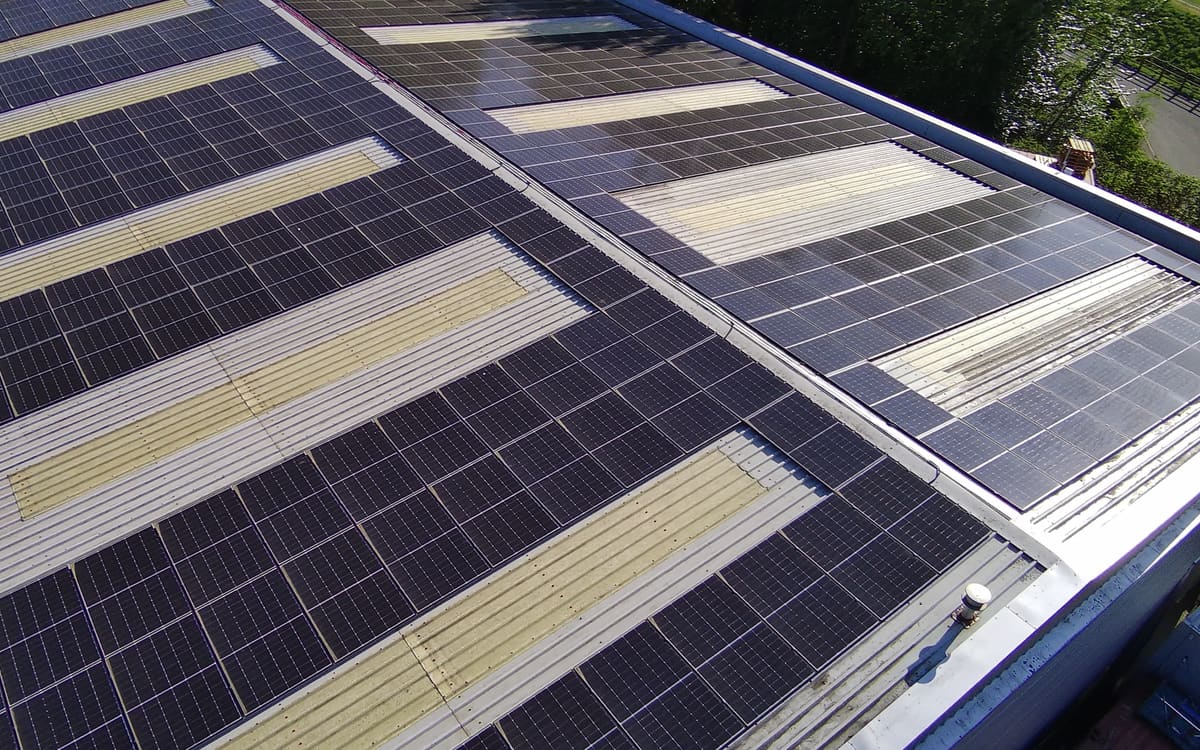
A 154 kWp rooftop array with 64 kWh of battery storage, sized to the daytime machinery load so generation is used the moment it is made.
Read the full case studyThe numbers, sourced
Warehouses solar in figures
Every figure below comes from a named public source, the same standard we hold our savings estimates to.
-
The UK's largest 20% of warehouses alone offer around 75 million m² of roof space, enough to support up to 15 GW of rooftop solar capacity, which would more than double the UK's installed solar at the time of the study.
Source: UK Warehousing Association (UKWA) / Delta Energy & Environment research report
-
Warehousing accounts for roughly a third of all UK commercial roof space, yet only about 5% of warehouse buildings have any solar panels installed.
Source: UK Warehousing Association (UKWA)
-
The "golden logistics triangle" covers around 289 square miles of the West Midlands and sits within a four-hour drive of 90% of the British population; UK business premises classified as transport and storage were 88% higher in 2021 than in 2011.
Source: Office for National Statistics, 'The rise of the UK warehouse and the golden logistics triangle' (April 2022)
-
The Government's Clean Power 2030 Action Plan states that there is "great potential for rooftop solar installation across the UK's warehouse and industrial sectors" — the first direct policy recognition of the sector's rooftop resource.
Source: Department for Energy Security and Net Zero (DESNZ), Clean Power 2030 Action Plan
-
SCI advisory note AD 541 warns that actual rooftop PV system weights are frequently around 0.35 kN/m² against a commonly assumed 0.15 kN/m², and recommends taking the imposed roof load as 0.4 kN/m² when combined with PV loading.
Source: Steel Construction Institute, Advisory Desk note AD 541 (New Steel Construction)
-
The 1 MW generation cap on rooftop solar for non-domestic buildings in England was removed with effect from 21 December 2023, bringing large warehouse arrays within permitted development subject to the remaining conditions.
Source: The Town and Country Planning (General Permitted Development etc.) (England) (Amendment) (No. 2) Order 2023, SI 2023/1279, legislation.gov.uk
-
Eligible plant and machinery used for on-site renewable generation and storage, including rooftop solar and batteries, is exempt from business rates in England from 1 April 2022 until 31 March 2035, applied automatically by the Valuation Office Agency with no application needed.
Source: HM Treasury Spring Statement 2022 green rates relief / Valuation Office Agency
-
Solar PV is special-rate plant for capital allowances purposes, so it is excluded from full expensing; companies must instead use the 50% special-rate first-year allowance or the Annual Investment Allowance (100% on up to £1m of qualifying spend).
Source: HMRC Capital Allowances Manual; Finance (No.2) Act 2023
-
Battery-electric vans made up 9.1% of new UK light commercial vehicle registrations in 2025, against a ZEV mandate share of 16% for 2025 rising to 24% in 2026, pushing depot charging demand up sharply for logistics operators.
Source: Society of Motor Manufacturers and Traders (SMMT) LCV registration data
Data last reviewed: July 2026
The next step
If you run a warehouse, distribution centre or logistics depot in Birmingham, the Black Country or the wider West Midlands, the honest first step is data rather than a quote. Our free Business Energy Survey pulls your half-hourly consumption, plots your daytime baseload, checks the roof structure and the right fixing method for your sheet profile, and comes back with an in-house CAD layout, a realistic export position and a payback figure you can put in front of a board, or a clear explanation of why the site does not stack up. Call 0121 661 6400 or book a survey and we will give you a straight answer either way.
Warehouses solar questions
How big an array will a typical warehouse roof take, and should we fill it?
As a rough planning figure, a modern portal-frame roof supports somewhere around 100-130 kWp of PV per 1,000 m² of usable, unshaded roof plane, before you deduct rooflights, gutters, plant, walkways and edge exclusion zones. But roof capacity is the wrong starting point. We size to your daytime electrical baseload from half-hourly data, because a unit you consume is worth several times a unit you export under a Smart Export Guarantee tariff. Harris Parts is a good example: 154 kWp plus 64 kWh of battery storage, sized around the site's daytime machinery load and documented to save around £16,000 a year. Filling every square metre of a big shed roof usually lengthens the payback rather than shortening it, unless you are pairing it with battery storage or heavy EV fleet charging.
Will our roof take the weight?
Usually yes, but it must be checked rather than assumed. Portal-frame sheds are deliberately light and the purlins, not the main frame, are normally the limiting element. SCI advisory note AD 541 highlights that real PV systems often weigh around 0.35 kN/m² where designers assumed 0.15 kN/m², and the array has to be assessed alongside imposed and snow loading. We commission a structural appraisal on older buildings, long purlin spans, or roofs that have already been re-clad or had plant added. Occasionally the outcome is that only part of the roof can be loaded, or that localised purlin strengthening is needed. We would rather tell you that at survey than after mobilisation.
Our forklifts and MHE charge overnight. Does solar still stack up?
It still stacks up, but the design changes. Overnight MHE charging sits outside the generation window, so it cannot be offset directly by daytime solar. Two routes work. First, look at whether charging can be shifted or split. Many li-ion MHE fleets opportunity-charge during shift breaks, which moves a meaningful slice of that load into daylight. Second, size the array to the loads that genuinely are daytime (high-bay lighting, conveyors, compressors, refrigeration, offices) and use battery storage to carry midday surplus into the evening charge window. We model both options against your actual half-hourly data before recommending a system size.
We lease our warehouse. Can we still install solar?
Yes, but the lease governs it. The array is an alteration to the landlord's building, so you will need a licence to alter, and you need a written position on three things: who owns the system, whether reinstatement is required at lease end, and how it is treated at rent review and in dilapidations. Term length is the practical test, a residual term comfortably longer than the payback is what makes it work. Where the term is short, the alternative is a landlord-funded array with the tenant buying the power, which is increasingly attractive to landlords because on-site renewables improve the EPC rating ahead of tightening non-domestic MEES requirements for larger commercial buildings.
Do we need planning permission for solar on a warehouse roof?
In England, most commercial rooftop solar is now permitted development. The 1 MW generation cap on non-domestic rooftop installations was removed by an amendment to the GPDO that took effect on 21 December 2023, which was the change that finally opened up large distribution roofs. Conditions still apply: projection above the roof plane, siting on listed buildings and in conservation areas, and the requirement to remove the equipment when no longer needed. The bigger consent hurdle is almost always the grid, not the council: every commercial array needs a G99 connection application to the DNO, and that is where programme risk sits.
Will the DNO let us export everything we generate?
Often not, and you should plan for that. In a network area as heavily loaded as the West Midlands, G99 offers for large rooftop arrays frequently come back with an export limit, enforced by an export limitation device, rather than unrestricted export. On a self-consumption-led design this is rarely a problem, because the value is in displacing imported power at the full delivered rate anyway. It only becomes material if you were relying on selling large summer surpluses. We submit the G99 application early and design to a realistic export position rather than assuming the best case, because DNO response times are the most common reason warehouse solar projects slip.
Other sectors we serve
-
Manufacturing & Factories
Heavy, steady daytime process load means the highest self-consumption of any sector.
-
Agricultural & Farm Buildings
Grain stores, dairies and workshops under big steel-portal roofs, often on constrained rural grids.
-
Poultry Farms
Ventilation, heating and lighting run right through daylight, exceptional self-consumption.
Get the numbers for your warehouses site
Get your free, no-obligation quote
Commercial solar, battery, EV or any electrical work — no pressure.