
Commercial Solar · West Midlands
Commercial Solar Panels in Solihull
Solihull is not the West Midlands stereotype. Where Oldbury, Smethwick and Tipton run on foundries and heavy manufacturing, Solihull runs on offices, business parks and distribution units, so commercial solar PV here is a roof-stock question rather than a spare-land question. Birmingham Business Park alone holds 2.4 million sq ft of office space across 148 acres. Blythe Valley Park sits in 122 acres off the A34 at M42 junction 4. Monkspath Business Park in Shirley provides 375,000 sq ft across 42 warehouse units. Large shallow-pitch and flat roofs, weekday-only occupancy and a heavy summer cooling load make for a very different design brief to a two-shift Black Country factory.
Green Tech Hub has been designing and installing commercial solar since 2015. We are based in Oldbury and cover Solihull and the wider West Midlands. We do not keep an office in the borough, and we would rather say so than pretend otherwise. What we bring is director-led delivery: a half-hourly consumption survey before any kWp figure is quoted, in-house CAD roof layouts, independently audited installations and a 25-year panel performance warranty. We are MCS certified (NIC-600049), RECC registered (00067281) and NICEIC approved, with more than 100 MW of commercial capacity designed. On a well-oriented Solihull roof you should expect roughly 900–1,000 kWh per kWp per year, and commercial paybacks typically land between three and five years.
Solar on Solihull's commercial buildings
An office at Blythe Valley or Birmingham Business Park has a load profile that suits solar unusually well. Base load runs roughly 07:00–19:00 Monday to Friday, and the largest summer load, comfort cooling, peaks with the same irradiance that peaks the array. On the days your chillers work hardest, your roof generates hardest. The caveat is the other half of that curve: a building that empties at 18:00 and stays empty all weekend exports a large share of a summer weekend's output, and an exported unit under SEG is worth a fraction of a self-consumed one. That is why we model half-hourly data before sizing, and why battery storage earns its keep more often on Solihull office sites than on continuous-process industrial ones.
Solihull's business-park roof stock is largely 1980s–2000s steel frame: shallow-pitch profiled metal decks on the industrial units, flat or near-flat single-ply membranes on the offices. Neither is a barrier, but both need surveying properly. On single-ply we normally specify ballasted, non-penetrating mounting to protect the membrane warranty, which shifts the structural question to imposed load and wind uplift rather than fixings. On profiled metal we check purlin spacing, sheet condition and remaining life, putting a 25-year array on a roof with eight years left in it is a false economy, and we will tell you that before you commit. Monkspath-style units with 6 m eaves and 5,000–15,000 sq ft footprints typically carry 50–150 kWp each, which is a different job from a single large distribution deck.
Our Harris Parts project: a 154 kWp rooftop array with 64 kWh of battery storage on a warehouse, documented at around £16,000 saved a year, is the closest analogue we have to the larger distribution units on Solihull's estates. For a multi-tenant office building the arithmetic is genuinely different, and we will not pretend one transfers to the other. Where the load profile is irregular rather than industrial, our GNG Gurdwara scheme is the more honest comparison: PV plus battery sized around a seven-day usage profile rather than a flat weekday base load.
Most Solihull business-park occupiers lease rather than own, and that is the single most common thing that stalls a scheme here. A tenant with six years left on a ten-year lease is buying a 25-year asset; a landlord who installs it is spending capital on a bill they do not pay. The workable structures are a landlord-funded system recovered through the service charge or a rent uplift, a licence to alter with an agreed dilapidations position so the array is not stripped at lease end, or a green-lease clause splitting the benefit. On multi-let estates the landlord's own supply: car park lighting, lifts, common areas and increasingly EV charging, is often a sound anchor load in its own right.
Business parks with several thousand commuters are exactly where daytime EV charging and rooftop solar reinforce one another: around 10,000 people work at Birmingham Business Park and roughly 3,500 at Blythe Valley. Cars sit under the array for eight or nine hours across the generating window, which converts would-be export into self-consumption at the full retail value of the unit. Load management then keeps the charging estate inside your existing DNO capacity rather than triggering a reinforcement application, which on a constrained business-park supply is often the difference between a scheme going ahead this year or not at all.
The other Solihull-specific driver is supply-chain reporting. JLR's Solihull plant on Lode Lane covers around 300 acres and employs over 10,000 people building Range Rover, Range Rover Sport and Velar. The tiers of suppliers, logistics operators and engineering firms clustered around it face increasingly specific Scope 3 questions from their customer, and metered on-site generation with MCS documentation is auditable evidence in a way a green tariff certificate is not. The same pressure applies to firms bidding into the Arden Cross and HS2 Interchange programme, where sustainability credentials are part of the prequalification.
On the money, be careful who you take advice from. Solar PV is special-rate plant, so it is excluded from full expensing. The routes that do apply are the 50% first-year allowance for special-rate assets or the Annual Investment Allowance at 100% up to £1m, for most Solihull commercial arrays the AIA covers the entire cost in year one. Onsite renewable generation and storage is also exempt from business rates in England until 31 March 2035. The domestic VAT zero rate does not apply to commercial premises, so budget the full 20% and reclaim it as normal. Anyone quoting you 'full expensing' or a '100% first-year allowance' on solar has the tax treatment wrong, and that should tell you something about the rest of their numbers.
What Solihull Metropolitan Borough Council is doing
Solihull Metropolitan Borough Council recognised a climate emergency in October 2019, setting a net zero target of 2041 for the borough, aligned with the West Midlands Combined Authority, and 2030 for the council's own operations. Its Climate Change Action Plan 2026–2030 has since replaced the earlier Net Zero Action Plan, and the council has installed solar PV on its own buildings alongside flagship work such as the Solihull Town Centre Energy Network.
The trajectory matters for anyone budgeting a scheme. The council reports its own net emissions down by over 51% since 2019/20, but borough-wide emissions down only around 38% since 2005, short of what the 2041 target requires. Commercial buildings are a substantial share of what remains, and Solihull's stock is weighted towards offices and business parks rather than heavy industry, which means rooftop PV on commercial premises is disproportionately where the remaining reduction has to come from.
On planning, rooftop solar on commercial buildings in England is largely permitted development under Part 14 of the GPDO, and the previous 1 MW rooftop cap was removed in November 2023. Prior approval for siting and appearance can still apply, and listed buildings and the borough's conservation areas are handled separately. For new build, Solihull's Local Plan (Draft Submission 2020) expects minor non-residential development to meet at least BREEAM Very Good and major non-residential development at least BREEAM Excellent, and attaches significant weight to low carbon and renewable energy schemes, thresholds that on-site generation helps satisfy. We confirm the constraint position with the council before design work starts, not after.
There is local precedent at scale. Birmingham Airport, on Solihull's boundary, commissioned a 6.8 MW solar farm of more than 12,000 ground-mounted panels at a cost of £9.7m, supplying at least 20% of the airport's electricity and saving around 1,285 tonnes of CO2 a year on the way to net zero Scope 1 and 2 emissions by 2033. The scale is different from a business-park roof, but the logic is identical: generate where you consume, and value the unit you avoid buying rather than the one you export.
Local facts, sourced
Solihull in numbers
Every figure below comes from a named public source, the same standard we hold our savings estimates to.
-
Solihull Metropolitan Borough Council recognised a climate emergency in October 2019, committing the borough to net zero by 2041 (in line with the West Midlands Combined Authority) and the council's own operations to net zero by 2030.
Source: Solihull Metropolitan Borough Council, Climate Emergency (solihull.gov.uk/your-future-solihull/climate-emergency)
-
The Solihull Climate Change Action Plan 2026–2030 replaces the earlier Net Zero Action Plan. Council net emissions are reported down over 51% since 2019/20, while borough-wide emissions are down around 38% since 2005, below the rate required to hit net zero by 2041.
Source: Solihull Metropolitan Borough Council, Solihull Climate Change Action Plan 2026–2030
-
Solihull's Local Plan (Draft Submission 2020) requires minor non-residential development to meet at least BREEAM Very Good and major non-residential development at least BREEAM Excellent, and attaches significant weight to low carbon and renewable energy schemes, particularly in the town centre and UK Central Hub area.
Source: Solihull Metropolitan Borough Council, Solihull Local Plan (Draft Submission) 2020
-
Birmingham Business Park covers 148 acres and 2.4 million sq ft of office space, with more than 150 businesses and around 10,000 employees including Rolls-Royce, IMI, Canon, Goodyear, GKN and Mitsubishi Electric, minutes from junction 6 of the M42.
Source: Birmingham Business Park (birminghambusinesspark.co.uk)
-
Blythe Valley Park sits in 122 acres of parkland off the A34 Stratford Road at junction 4 of the M42, accommodating over 25 companies and roughly 3,500 employees across R&D, fashion retail, industrial and logistics space, including Gymshark, Lounge, Siemens and Oracle.
Source: Blythe Valley Park / IM Properties (blythevalleypark.co.uk, improperties.co.uk)
-
Monkspath Business Park on Highlands Road, Shirley comprises 42 modern warehouse units totalling 375,000 sq ft, steel frame with single-storey front offices and a minimum 6 m eaves height, adjacent to the A34 with direct access to M42 junction 4. Occupiers include Farmfoods, John Lewis and DHL.
Source: Canmoor, Monkspath Business Park estate brochure (canmoor.com, via Savills)
-
JLR's Solihull plant on Lode Lane occupies around 300 acres (120 hectares) with a workforce of more than 10,000, building the Range Rover, Range Rover Sport and Range Rover Velar, JLR's largest UK factory and the anchor of a substantial local automotive supply chain.
Source: JLR Media Newsroom — 'A Manufacturing Success Story' / Solihull plant
-
Birmingham Airport, on Solihull's boundary, commissioned a 6.8 MW solar farm of more than 12,000 ground-mounted panels at a cost of £9.7m, supplying at least 20% of the airport's electricity and saving around 1,285 tonnes of CO2 a year, en route to net zero Scope 1 and 2 emissions by 2033.
Source: Birmingham Airport, Net Zero Carbon Plan / Airport World
-
The Arden Cross / UK Central Hub development around the HS2 Interchange station covers around 140 hectares (346 acres) and is planned to support up to 27,000 jobs, 3,000 new homes and approximately 6 million sq ft of employment space.
Source: West Midlands Combined Authority, West Midlands Investment Prospectus 2023 (The UK Central Hub, Solihull)
-
Solihull borough had a population of 216,240 at the 2021 Census, up 4.6% from around 206,700 in 2011; the town of Solihull itself recorded 126,577 residents.
Source: Office for National Statistics, Census 2021, How the population changed in Solihull (E08000029)
-
A south-facing 4 kWp array at 35 degrees in Solihull is modelled at 3,881 kWh a year, 970 kWh per kWp, so a 100 kWp business-park roof generates roughly 97,000 kWh; the borough sits on National Grid Electricity Distribution's West Midlands licence area, confirmed on real B91 postcodes.
Source: European Commission JRC, PVGIS 5.3 (SARAH3), Solihull, 4 kWp, south, 35 degrees, 14% system loss; Octopus Energy grid-supply-point API
Data last reviewed: July 2026
Proof
Work we have actually done.
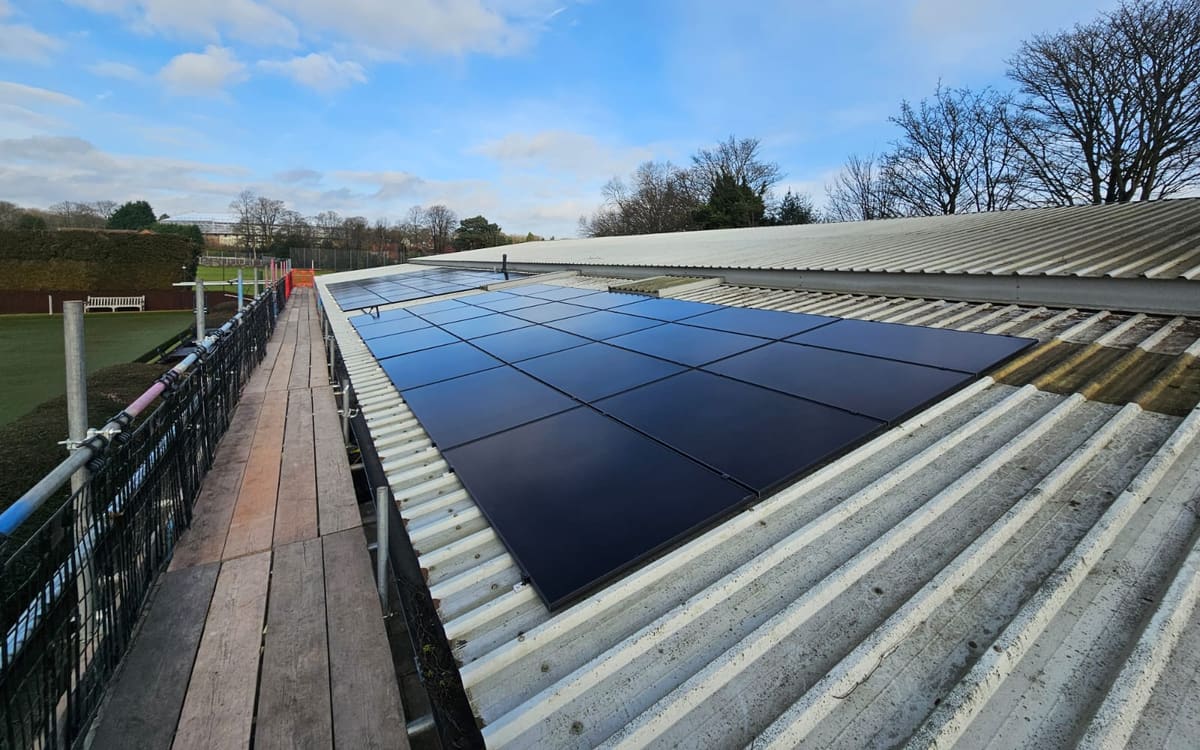
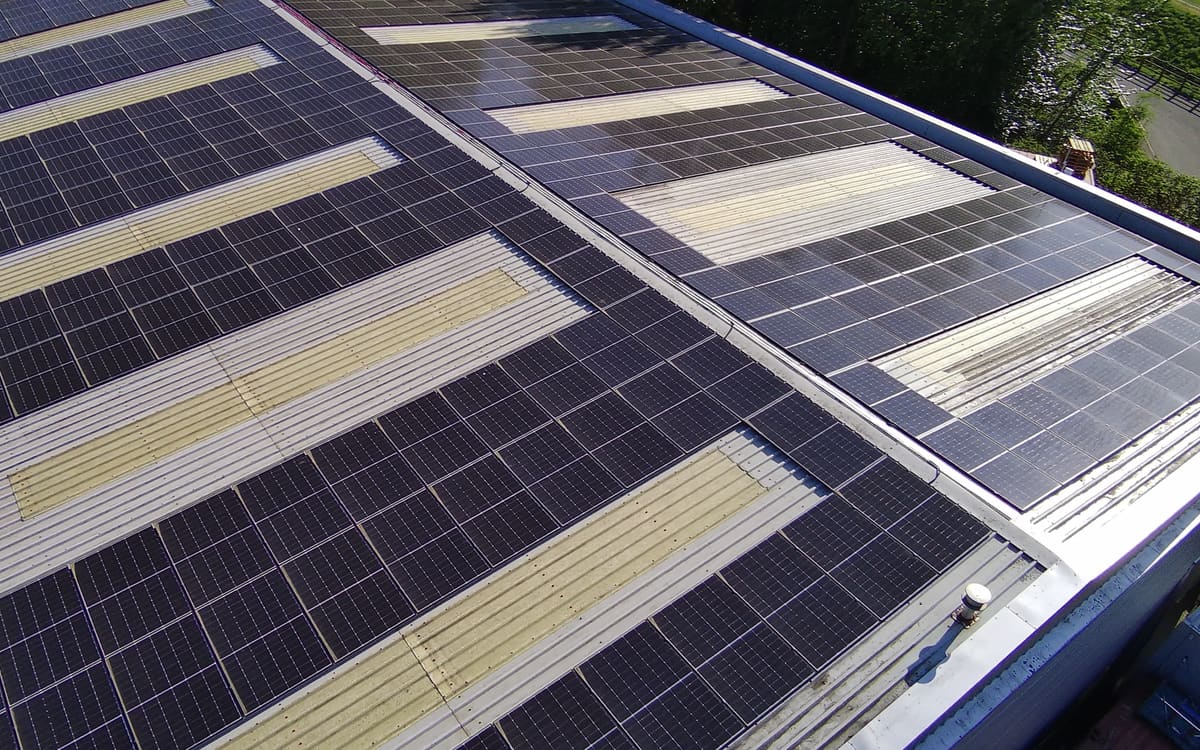
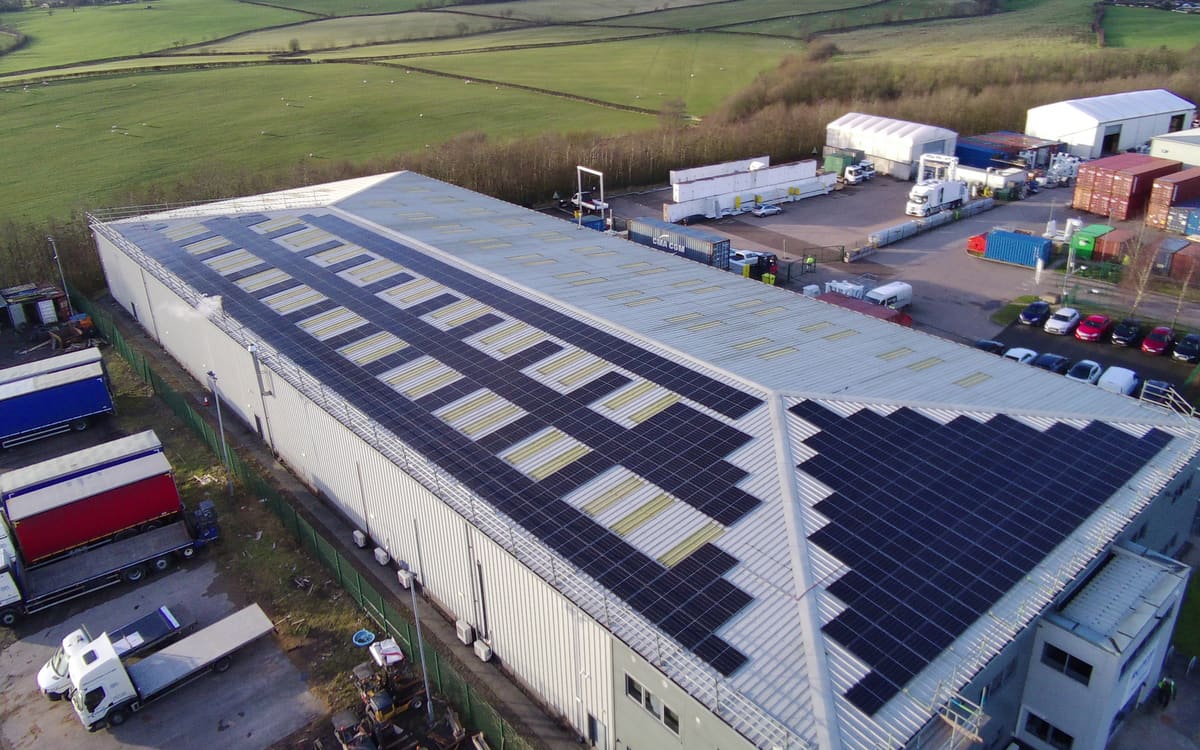
Recent Green Tech Hub installations across the West Midlands and beyond — every photo is our own project, not stock imagery.
The next step
Thinking about solar for a Solihull office, business park unit or distribution warehouse? Start with the data, not a roof measurement. Send us twelve months of half-hourly consumption and we will model realistic generation, self-consumption and payback for your specific site, including an honest view on lease structure, roof condition and available capital allowances. Director-led throughout, MCS certified (NIC-600049), with fully funded and PPA options available on installations above 100 kW. Call Green Tech Hub on 0121 661 6400 to arrange a survey.
Solihull commercial solar questions
Which network operator handles a G99 application in Solihull?
National Grid Electricity Distribution's West Midlands licence area, confirmed on real Solihull postcodes, so the same team that covers the Black Country rather than the East Midlands team that covers Birmingham itself. Any system above 3.68 kW per phase, which is every commercial array, needs a G99 application approved before installation; on larger systems the operator may set an export limit or ask for a connection upgrade. The application is the slowest part of a project, measured in weeks, so we submit it as soon as the design is agreed, and it is in our fixed price.
We lease our unit at Birmingham Business Park, can we still install solar?
Usually, yes, but the lease governs it rather than the roof. You will need landlord consent and almost certainly a licence to alter, with an agreed dilapidations position so the array is not stripped out at lease end. The commercial test is remaining term against payback: with a three-to-five year payback, a tenant with seven or more years left generally has a straightforward case, while a shorter term normally points to a landlord-funded scheme recovered through the service charge or a rent uplift, or a green-lease clause splitting the saving. Ballasted, non-penetrating systems help here. They are demountable and do not breach the membrane, which materially softens the landlord's objection. We are happy to put the technical case in writing for your landlord or managing agent.
Do we need planning permission for commercial solar in Solihull?
For most commercial rooftop installations, no. Rooftop solar on commercial buildings in England is largely permitted development under Part 14 of the GPDO, and the previous 1 MW rooftop cap was removed in November 2023, so system size is rarely the constraint it once was. Prior approval for siting and appearance can still apply, and listed buildings and Solihull's conservation areas are handled separately and need checking individually. New-build schemes are a different matter: Solihull's Local Plan (Draft Submission 2020) expects major non-residential development to meet at least BREEAM Excellent and minor non-residential at least BREEAM Very Good, and on-site generation contributes to those scores. We confirm the constraint position with Solihull Metropolitan Borough Council before we design, so the layout you see is the layout you can build.
Our Solihull office is only occupied Monday to Friday, 8am to 6pm. Is solar still worth it?
Yes, and often better than the occupancy pattern suggests, but the sizing has to be honest about it. Weekday office demand overlaps the generating window almost exactly, and comfort cooling, your biggest summer load, rises and falls with the same irradiance that drives the array, so summer self-consumption on a well-sized office system is typically high. The weakness is weekends and the Christmas shutdown, when generation continues and demand collapses. Those units export under SEG at a fraction of what you pay to import, so an array sized to your peak rather than your base load will disappoint. We size from your half-hourly consumption data, which tells us exactly how much of each year's output you would actually consume, and we will show you whether a battery closes the weekend gap economically on your site or simply adds capital cost.
What output should we realistically expect from a Solihull roof?
Around 900 to 1,000 kWh per kWp per year on a well-oriented, unshaded Solihull roof. A 250 kWp array on a business-park office or distribution unit therefore generates roughly 225,000 to 250,000 kWh annually. What determines your payback is not that figure but the proportion you self-consume: a unit you use is worth your full import price including standing charges and levies, while an exported unit earns a much lower SEG rate. Two identical arrays on adjacent Solihull units can return very different paybacks purely on load profile, which is why we survey the half-hourly data first rather than quoting from roof area. Expect three to five years for most commercial sites here, and be sceptical of anyone promising materially better without having seen your consumption.
Will a 1990s business-park roof in Solihull actually take an array?
Most will, but it is a structural question we answer before quoting, not after. On the flat and near-flat single-ply membranes common on Solihull's office buildings we specify ballasted, non-penetrating mounting to preserve the membrane warranty, which makes the check one of imposed load and wind uplift. On the shallow-pitch profiled metal decks typical of the industrial units at Monkspath and similar estates we assess purlin spacing, sheet condition and remaining roof life. If the roof has less than a decade left, we will recommend re-roofing first and installing afterwards rather than fitting a 25-year asset to a covering that will need lifting long before then. That advice costs us a sale sometimes; it costs you far more if nobody gives it.
Can you combine solar with EV charging for our business park car park?
That combination works particularly well on Solihull's larger parks, where several thousand vehicles arrive around 08:00 and leave around 17:30: Birmingham Business Park supports around 10,000 employees and Blythe Valley roughly 3,500. Cars parked through the generating window absorb output that would otherwise be exported, converting it to self-consumption at full retail value while providing a genuine staff and tenant benefit. The practical constraint is almost always the incoming supply rather than the roof: adding chargers without load management can push a site over its agreed capacity and trigger a costly DNO reinforcement. We design the PV, charging and load management together, so the charging estate operates inside the capacity you already have wherever that is achievable.
What does commercial solar cost in Solihull?
On DESNZ's 2025/26 cost data the West Midlands mean was £1,233 per kW for 10 to 50 kW systems, so a 100 kWp array on a business-park unit is about £123,300 as an average job, and larger systems on a good steel-deck roof usually come in below that. The single-ply membranes common on Solihull offices need ballasted mounting, which is the main thing that pushes a quote above the average. Our fixed price includes the structural survey and the G99 application.
What does a 100 kWp system save a Solihull business?
PVGIS models about 970 kWh per kWp a year in Solihull, so 100 kWp makes roughly 97,000 kWh. An office using 60% of that on site at the Q1 2026 average non-domestic price of 24.14p per kWh, and exporting the rest at around 12p, saves about £18,700 a year; with workplace EV charging lifting self-use to 80%, about £21,000. The worked example is in our Solihull savings post, and the survey replaces those assumptions with your own half-hourly data.
Nearby
We also cover solar for Sutton Coldfield businesses, Stourbridge commercial solar installers and commercial solar in Halesowen.
Homes too
Not a business? We also install solar panels and batteries for homes in Solihull, from the same Oldbury office.
Get a straight answer for your Solihull site
Get your free, no-obligation quote
Commercial solar, battery, EV or any electrical work — no pressure.