
Commercial Solar · Offices
Solar Panels for Offices & Business Parks
An office is, energetically, an electricity building. Across England and Wales the offices sector is the single largest consumer of non-domestic energy: 27,620 GWh a year, around 17% of the total, and roughly 68% of that is electricity, against 53% for the non-domestic stock as a whole (BEIS Building Energy Efficiency Survey). Lighting, comfort cooling, server and comms rooms, ICT and small power all draw hardest between roughly 8am and 6pm, Monday to Friday, and cooling demand peaks in exactly the months when a rooftop array is producing most. Very few building types match a solar generation curve as closely as an occupied office does.
The buildings suit it too. Business park units, 1980s–2000s office blocks and modern speculative floorplates typically present either a large uninterrupted flat roof, single-ply, built-up felt or a shallow-pitched metal deck, or a low-pitch profiled roof with a clean southern or east–west aspect. Unlike an industrial shed, an office roof is usually already designed for maintained plant access, so the practical questions become how to work around the condensers, air handling units and roof lights rather than whether the roof can be reached at all. Green Tech Hub has been designing and installing commercial solar PV from Oldbury since 2015, with over 100 MW designed and every scheme drawn in-house in CAD before a price is issued.
What makes offices different from every other sector we work in is that the decision is rarely made by the person paying the electricity bill. Energy in the offices, retail and hospitality sectors is predominantly consumed in rented premises, so a rooftop scheme has to be resolved as a property question as much as an engineering one: whose meter, whose roof, whose lease, whose EPC. That pressure is only increasing: sub-standard F and G rated commercial property has been unlettable since April 2023 under MEES, and the Government's June 2026 interim response proposes EPC B from 2031 for privately rented buildings over 1,000 m². We start every office project with a half-hourly consumption survey so the conversation begins with your actual weekday load shape rather than a roof area multiplied by an optimistic yield figure.
Most of the office roofs we survey are in and around the city: our commercial solar panels Birmingham page sets out costs, process and the areas we cover, and the Solihull business parks have their own page on commercial solar Solihull.
Why solar works on offices
The economics of an office array rest almost entirely on self-consumption. A unit you generate and use on site displaces the full delivered price of imported electricity: the commodity, network charges, policy costs and the Climate Change Levy that sits on top of business supplies. A unit you export earns only the Smart Export Guarantee tariff your supplier offers. For reference, DESNZ recorded manufacturing-sector electricity at 16.5p per kWh in Q3 2025 excluding CCL, while Ofgem's SEG annual report for 2024–25 shows £56.97 million paid across 443 GWh of export. The gap between those two numbers is the whole business case. An office that is genuinely occupied Monday to Friday can typically self-consume a high proportion of a correctly sized array, which is why office schemes in the West Midlands commonly land in the three-to-five-year payback range that we see across our commercial portfolio.
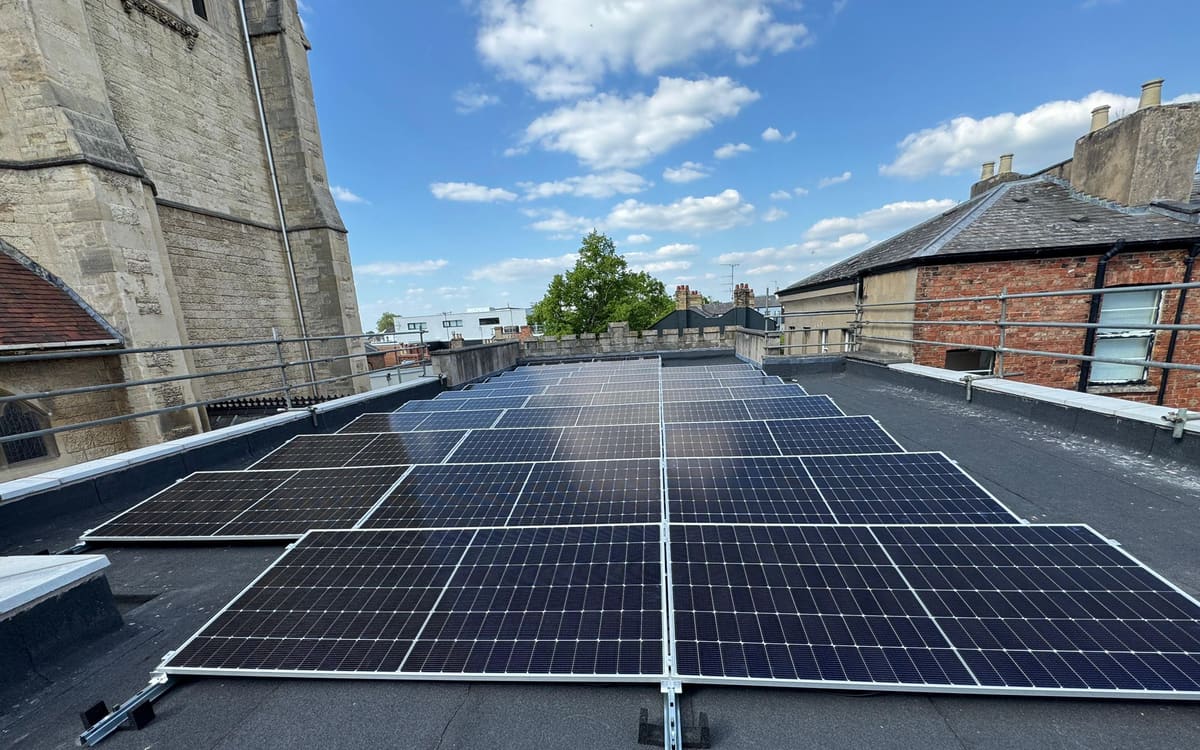
Roof type then drives the design. On a flat roof the default is a ballasted system: aluminium trays sitting on protection mats over the membrane, weighted with concrete rather than fixed through the waterproofing, which preserves the roofing warranty. Here the real decision is orientation. A south-facing array at around 10–20° maximises total annual kWh but needs wide inter-row spacing to avoid self-shading, so you fit fewer kWp per square metre. An east–west configuration packs panels back-to-back at a shallow pitch, fits substantially more capacity onto the same roof, and produces a flatter, broader curve with stronger morning and late-afternoon output. For an office running 8am to 6pm, that flatter shape often self-consumes better than a taller south-facing peak, even though it generates fewer total units. On a pitched or profiled metal roof the panels follow the plane on non-penetrative seam clamps or purpose-made fixings, and the design question shifts to purlin capacity and existing roof condition instead.
Rooftop plant is the constraint unique to this sector. Office roofs carry condensers, chillers, AHUs, lift motor rooms, flues, satellite dishes and roof lights, all of which cast moving shadows and all of which need maintained access. Ignoring them produces an array that looks impressive on a drawing and underperforms in service. We survey the roof, model the shading through the year, keep statutory access routes and plant clearances clear, and use panel-level or string-level electronics where a partial shade path cannot be designed out. Combining that with battery storage lets an office hold surplus generation from a quiet Friday or a bright Sunday and release it into Monday morning start-up, which is often the difference between a good and a marginal self-consumption figure on a five-day site.
The other lever is turning surplus generation into a demand you do not currently have. Staff cars sit in an office car park for seven or eight hours in the middle of the day, so adding workplace EV charging soaks up midday output that would otherwise be exported at low value, while supporting salary-sacrifice EV schemes and giving you a visible, defensible number for ESG and SECR reporting. Grant support currently exists for it: from 1 April 2026 the Workplace Charging Scheme pays up to £500 per socket, covering up to 75% of purchase and installation costs for up to 40 sockets, running to 31 March 2027. For estate owners with several buildings, the staged approach we used on the multi-site Clifton Diocese rollout applies well to office portfolios: start with the sites where consumption and roof condition are strongest, prove the model, then extend.
What to weigh up first
The honest weakness of an office array is the calendar. A typical office is occupied five days in seven and shuts down over Christmas and bank holidays, so a meaningful slice of summer generation lands on days when the building is nearly empty. That electricity is still worth something, but only at the export tariff, a fraction of what the same unit is worth on a Tuesday afternoon. Hybrid working has sharpened the problem: the ONS found 28% of workers in Great Britain were hybrid in early 2025, and in most offices that shows up as a materially lighter Monday and Friday. If your consumption model is built on pre-2020 data, it will overstate self-consumption. We size against your actual recent half-hourly weekday base load, not against the roof area or a peak-day snapshot.
Then the roof itself. Flat commercial roofs have a finite membrane life, and there is no sensible way to install a ballasted array over a single-ply or felt covering with under ten years left in it: the right order is re-roof first, PV second, or the array comes off again at your cost. Ballast adds distributed and point loads that need a structural engineer's sign-off, and older 1980s–90s office decks are not always sitting on spare capacity. Wind uplift also eats area: permitted development in England requires equipment to sit no more than one metre above the highest part of the roof and at least one metre in from external edges, and good wind-load practice usually pushes the array further in still. Add statutory access routes and clearance around AC condensers, AHUs, lift motor rooms and roof lights, and a gross roof area of 1,500 m² can realistically host far less array than a first glance suggests.
Tenure is the caveat most office schemes trip over. In a multi-let building you need to establish who owns the roof, whose meter the generation lands behind, and whether the landlord's supply (usually landlord services and common parts) is big enough to absorb it, because it is often much smaller than the tenants' combined demand. Cost recovery through the service charge is only available where the lease genuinely permits it and where tenants benefit, which is exactly the territory the Better Buildings Partnership's Green Lease Toolkit exists to address; it may need renegotiation, superior landlord consent or lender consent. Be realistic about EPC uplift too: an EPC is an SBEM-modelled asset rating, so the improvement depends on array output relative to floor area. A modest array on a large office can move the score less than owners expect, and MEES improvements are still filtered through the seven-year payback test. We will tell you before survey stage if PV alone is unlikely to shift your rating.
Finally, connection and disruption. Every commercial array needs a G99 application to your DNO, and city-centre and dense business-park sites in the West Midlands sometimes sit on constrained LV networks; you may be offered a connection with export limitation. For a self-consumption-led office scheme that is usually acceptable, but it has to be modelled at design stage rather than discovered at commissioning. Physically, the work is less invasive than in an industrial building, but it is not invisible: expect roof access arrangements, possibly a crane lift over a live car park, containment routes through occupied floors or risers, and a short out-of-hours shutdown to tie into the main switchboard. We programme those elements around your occupancy, and the install is independently audited on completion.
Proof
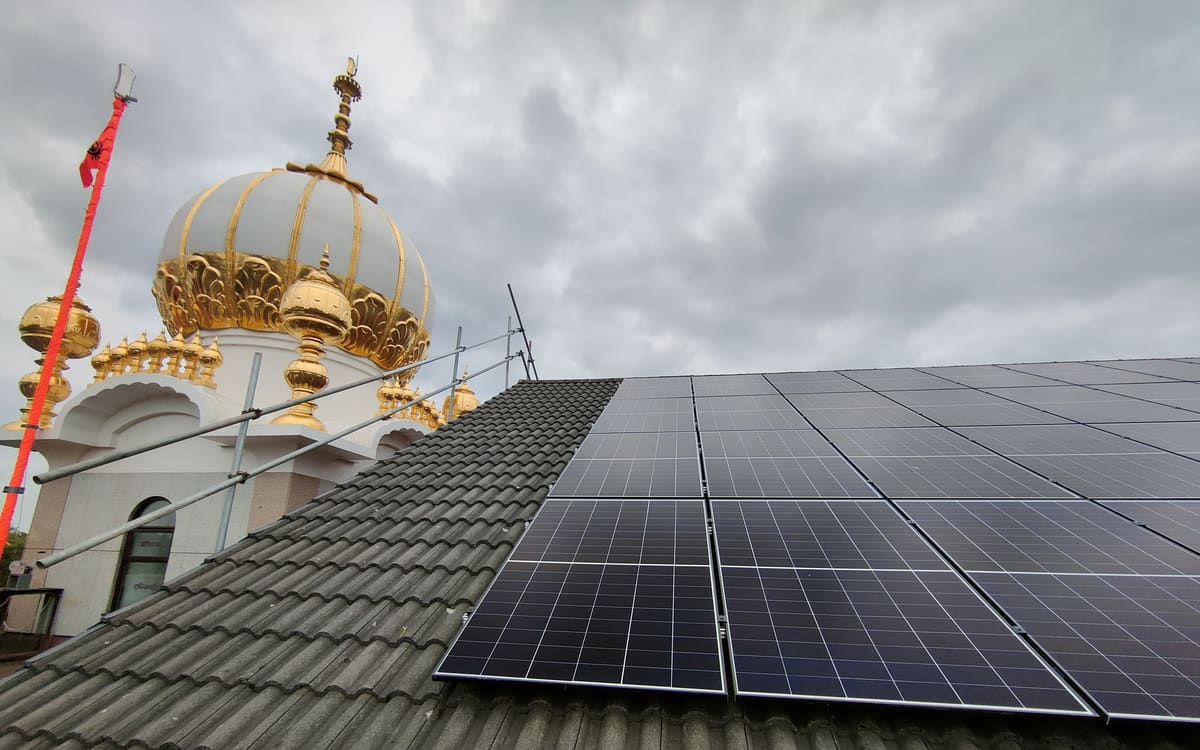
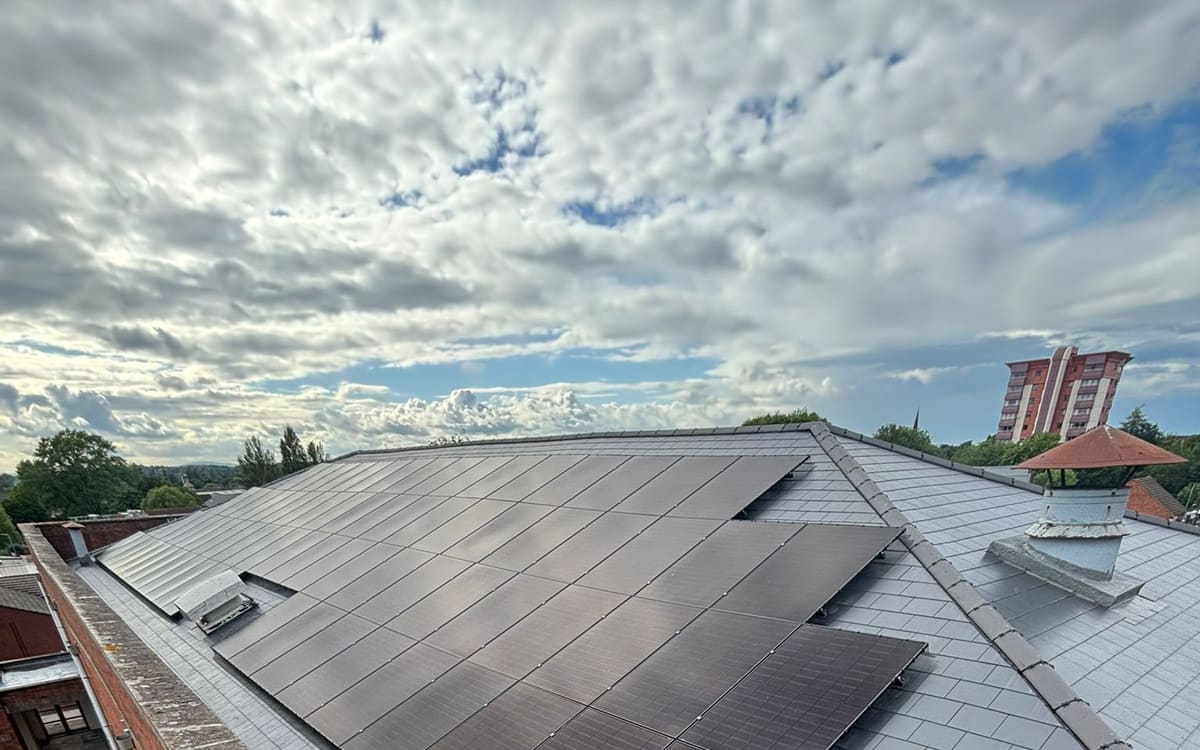
Real installs, real roofs.
We have no published offices case study yet — so here is our actual recent work instead. Every photo on this site is a Green Tech Hub installation.
The numbers, sourced
Offices solar in figures
Every figure below comes from a named public source, the same standard we hold our savings estimates to.
-
Offices are the single largest energy-consuming non-domestic sector in England and Wales, using 27,620 GWh a year, around 17% of all non-domestic energy consumption.
Source: BEIS (now DESNZ), Building Energy Efficiency Survey (BEES) 2014–15, Executive Summary
-
Electricity accounts for 68% of energy use in the offices sector, against 53% across the non-domestic building stock as a whole, offices are electricity-dominated buildings.
Source: BEIS (now DESNZ), Building Energy Efficiency Survey (BEES) 2014–15
-
In the offices, retail and hospitality sectors, energy is predominantly consumed in rented premises: which is why landlord/tenant structure, not roof area, is usually the binding constraint on office solar.
Source: BEIS (now DESNZ), Building Energy Efficiency Survey (BEES) 2014–15
-
Since 1 April 2023 it has been unlawful for landlords to continue to let commercial property in England and Wales with an EPC rating below E, unless a valid exemption is registered.
Source: The Energy Efficiency (Private Rented Property) (England and Wales) Regulations 2015 (MEES), GOV.UK
-
The Government's interim response of 18 June 2026 confirmed the proposed EPC C milestone for 2027 will not be taken forward; instead it is proposed that from 2031 privately rented non-domestic buildings over 1,000 m² reach EPC B, with buildings below 1,000 m² remaining at the EPC E minimum. The seven-year payback test and exemptions remain.
Source: DESNZ, 'Minimum Energy Efficiency Standards (MEES) in the non-domestic Private Rented Sector: interim response', GOV.UK, 18 June 2026
-
The 1 MW generation cap on rooftop solar under permitted development for non-domestic buildings in England was removed in November 2023. Class J conditions still apply: equipment must sit no more than 1 metre above the highest part of the roof (excluding chimneys) and at least 1 metre from external edges.
Source: Town and Country Planning (General Permitted Development) (England) Order 2015, Schedule 2, Part 14, Class J, as amended
-
Eligible plant and machinery used in on-site renewable energy generation and storage, including rooftop solar and battery storage, is exempt from business rates until 31 March 2035. The relief was announced at Autumn Budget 2021 and brought forward to take effect from April 2022.
Source: HM Treasury, Autumn Budget 2021 and Spring Statement 2022 (green business rates reliefs)
-
Solar PV is a special rate (integral features / long-life asset) expenditure, so it is excluded from full expensing. The available routes for companies are the 50% special-rate first-year allowance or the Annual Investment Allowance at 100% on up to £1m of qualifying spend.
Source: HMRC Capital Allowances Manual and GOV.UK full expensing guidance
-
Electricity purchased by consumers in the manufacturing industry averaged 16.5p per kWh in Q3 2025 (cash terms, excluding the Climate Change Levy). The Climate Change Levy is charged on supplies of electricity and gas to businesses and public sector organisations, on top of the unit price.
Source: DESNZ, Quarterly Energy Prices, December 2025
-
Ofgem's Smart Export Guarantee Annual Report for April 2024 to March 2025 records £56.97 million paid out for 443 GWh of exported electricity across the scheme.
Source: Ofgem, Smart Export Guarantee Annual Report, April 2024 – March 2025
-
28% of workers in Great Britain were hybrid workers between 8 January and 30 March 2025, compared with around 55% based permanently at a single workplace, a direct influence on weekday office base load.
Source: Office for National Statistics, 'Who has access to hybrid working in Great Britain?', June 2025
-
From 1 April 2026 the Workplace Charging Scheme grant rose from £350 to £500 per socket, covering up to 75% of the purchase and installation cost (inclusive of VAT), for up to 40 sockets per applicant. The scheme has been extended for a final year to 31 March 2027 and requires an OZEV-authorised installer.
Source: GOV.UK, 'Changes to electric vehicle chargepoint grant schemes from 1 April 2026' and Workplace Charging Scheme guidance
-
Large unquoted UK companies and LLPs: those meeting two of: turnover over £36m, balance sheet total over £18m, or more than 250 employees, must report UK energy use and greenhouse gas emissions in their annual report under SECR.
Source: The Companies (Directors' Report) and Limited Liability Partnerships (Energy and Carbon Report) Regulations 2018 (SI 2018/1155)
-
MCS-accredited yield calculations use zone-based irradiance (Kk) tables derived from the European Commission's PVGIS dataset, dividing the UK into 21 zones with values for each roof pitch and orientation. Well-oriented West Midlands roofs typically fall in the region of 900–1,000 kWh per kWp per year.
Source: MCS MIS 3002 irradiance datasets, derived from European Commission PVGIS data
Data last reviewed: July 2026
The next step
If you run, own or manage an office or business park in Birmingham or the wider West Midlands, the useful next step is data, not a brochure. Our free Business Energy Survey starts with your last 12 months of half-hourly consumption so we can see your real weekday shape, your weekend and holiday troughs and how much of a proposed array you would actually self-consume: then we model the usable roof area in CAD around your plant, access routes and edge setbacks, and give you an honest yield, cost and payback figure. If the numbers do not work, we will say so. Call Green Tech Hub on 0121 661 6400 or request a survey and a director will walk the roof with you.
Offices solar questions
We have a flat roof with a single-ply membrane. Can solar be installed without penetrating it?
Yes, in most cases. The standard approach on a commercial flat roof is a ballasted mounting system: aluminium trays or frames sit on protection mats over the membrane and are held down by concrete blocks or pavers, with no fixings through the waterproofing. That keeps your roofing warranty intact, and we will engage your roofing contractor or warranty provider before we start so it is confirmed in writing rather than assumed. Two conditions have to be met first. The membrane needs enough remaining service life to justify putting an array on top of it, if it has less than roughly ten years left, re-roofing first is the cheaper decision overall. And the ballast weight has to be checked by a structural engineer against the deck's spare capacity, because ballasted systems add both distributed load and concentrated point loads. Where the deck cannot take ballast, the alternatives are a lighter east-west system, a reduced array, or mechanically fixed rails installed with the roofing contractor to preserve the warranty.
Our office is only occupied Monday to Friday. Does that ruin the payback?
No, but it changes how the system should be sized. Weekday-only occupancy is actually one of the better load profiles for solar, because your heaviest demand: lighting, comfort cooling, servers, ICT and small power, occurs during daylight hours across the same months that generation peaks. What weekend closure does is cap how large an array makes sense. Roughly two sevenths of the year's generation lands on days when the building is close to empty, and that electricity earns only an export tariff rather than displacing electricity you would otherwise buy. The result is that a correctly sized office array is usually smaller relative to roof area than an equivalent seven-day site would justify. It is not a reason to avoid solar; it is a reason to size against measured half-hourly weekday consumption. Where a client wants to use more of the roof, battery storage or workplace EV charging can shift some of that weekend and shoulder generation back into value.
We are the landlord of a multi-let office building. Who actually benefits from the solar, and can we recover the cost through the service charge?
This has to be settled before design, not after. First, establish which meter the generation sits behind. In most multi-let buildings the practical option is to connect behind the landlord's supply, so the array offsets common parts and landlord services: lifts, lighting, common area heating and cooling, car park and reception. That is a genuine saving but it is usually a smaller load than the tenants' combined demand, which limits how much you can self-consume. Supplying tenants directly is possible but involves private wire arrangements, metering and supply licensing questions that need legal advice. Second, on recovery: it depends entirely on the wording of your leases. Service charge recovery of an improvement is only available where the lease permits it and where tenants receive a benefit; the Better Buildings Partnership's Green Lease Toolkit sets out clause approaches for exactly this, and it may require renegotiation at renewal, plus superior landlord or lender consent. We are happy to produce the technical and financial pack your solicitor and surveyor need.
Will solar panels improve our EPC rating and help us meet MEES?
They will improve it, but be realistic about how much. A commercial EPC is a modelled asset rating produced by SBEM, and on-site renewable generation reduces the modelled primary energy and carbon figures, so the score moves in the right direction. The size of the move depends on the array's annual output relative to the building's floor area and the rest of the fabric and services. A well-sized array on a small or medium office can shift a rating band; the same array on a large floor plate may only nudge the number. Solar is also rarely the cheapest first move: lighting, controls, heating plant and fabric measures often give more EPC points per pound. Since 1 April 2023 it has been unlawful to continue letting sub-standard (F or G) commercial property in England and Wales, and the June 2026 interim response proposes EPC B from 2031 for privately rented buildings over 1,000 m², with the seven-year payback test retained. We will model the likely EPC effect before you commit, and tell you if PV alone will not get you where you need to be.
Do we need planning permission for solar panels on our office or business park unit?
Usually not in England. Rooftop solar on non-domestic buildings generally falls under permitted development (Class J), and the previous 1 MW generation cap was removed in November 2023, so array size is no longer the limiting factor. The conditions still bite, though: equipment must project no more than one metre above the highest part of the roof, must sit at least one metre in from external edges, and must be sited to minimise visual impact. Those setbacks reduce usable roof area, particularly on smaller flat roofs. Permitted development does not apply if your building is listed, and installations in conservation areas or on buildings within the curtilage of a listed building need separate consent and are often assessed on visibility from the highway. Business parks may also carry estate covenants or design codes that are contractual rather than planning matters. We check title, planning designation and estate restrictions as part of the survey, and submit the G99 connection application to the DNO regardless of the planning route.
Can we combine rooftop solar with EV charging for staff and visitors?
Yes, and offices are one of the sectors where the pairing genuinely works. Cars sit in an office car park for seven or eight hours during exactly the window when the array is generating, so workplace charging converts surplus midday generation into self-consumed electricity rather than low-value export. It also gives you something staff can see, which matters for recruitment and for ESG reporting. The practical constraints are electrical rather than solar: you need spare capacity at the main switchboard and often load management so chargers throttle rather than trip the incomer, plus a decision on whether staff are billed. Grant support is available: the Workplace Charging Scheme rose to £500 per socket from 1 April 2026, covering up to 75% of purchase and installation costs for up to 40 sockets, and has been extended to 31 March 2027, but it must be claimed through an OZEV-authorised installer. We design PV, storage and charging as one electrical scheme so the capacity assessment is done once.
Other sectors we serve
-
Student Accommodation
All-inclusive bills mean every kWh generated lands straight on the operator's P&L.
-
HMO & Apartment Blocks
Communal supply, lifts, corridor lighting and pumps, is the load solar pays down.
-
Glamping & Leisure
Summer-peak demand meets summer-peak generation, often on a weak rural connection.
Get the numbers for your offices site
Get your free, no-obligation quote
Commercial solar, battery, EV or any electrical work — no pressure.