
Commercial EV Charging · Birmingham & the West Midlands
Commercial EV charging, sized to your supply.
Fleet, staff and visitor charge points designed by the people who survey your board, not by a catalogue. We measure the load first, share the headroom intelligently, and link the chargers to your own generation so the cheapest fuel on site is the one from your roof.
Three different jobs
Fleet, staff and visitors are not the same install.
Most disappointing commercial charging schemes come from treating these three as one requirement. They have different dwell times, different funding routes and different billing needs, which means they should be specified separately, even when they share a car park.
Fleet charging
Vans and cars that must be full by a fixed time.
Fleet is the only one of the three cases with a hard deadline. Vehicles return late, sit on the yard overnight and have to be at full state of charge by first shift. That makes overnight AC charging almost always the right answer — long dwell, low power per socket, cheap off-peak import — with the schedule handled centrally rather than by drivers plugging in and hoping.
Staff / workplace charging
Cars parked 8+ hours, all wanting power at 09:00.
Workplace charging is a benefit, not a service you sell. The trap is everyone arriving in the same half hour: ten 7 kW sockets is a 70 kW simultaneous demand on a board that may not have it. Because dwell is long, sockets can share power intelligently instead of each needing a dedicated full-rate circuit — which is what makes workplace charging affordable at scale.
Visitor & customer charging
Short dwell, unknown drivers, payment required.
Customer and visitor bays are a different product: shorter dwell means higher power per socket, and you need authentication, tariffs and billing because the driver is not on your payroll. Note the funding difference too — visitor and customer parking does not qualify for the Workplace Charging Scheme, so these bays are normally justified on dwell-time value or paid charging, not on grant.
The real constraint
The charger is rarely the problem. The supply is.
Choosing a charge point takes an afternoon. Finding out three weeks before install that your incomer cannot support it costs months. So we start at the other end: what does the site actually draw, half-hour by half-hour, and how much headroom is genuinely spare when the compressors, chillers and machinery are all running?
That measurement usually changes the answer. Dynamic load management lets a bank of chargers share whatever capacity is free at that moment and throttle back the instant the building needs it, so the site adds charging without adding a single amp of contracted capacity. It is the difference between a straightforward electrical job and a network reinforcement quote with a lead time measured in quarters.
Honest position
Sometimes the headroom really is not there, and no amount of clever software creates it. When that is the case we say so at survey stage, quantify the reinforcement, and let you decide, rather than discovering it once your deposit is paid. The same director-led survey discipline we apply to commercial solar applies here.
WAREHOUSE · PV + BATTERY
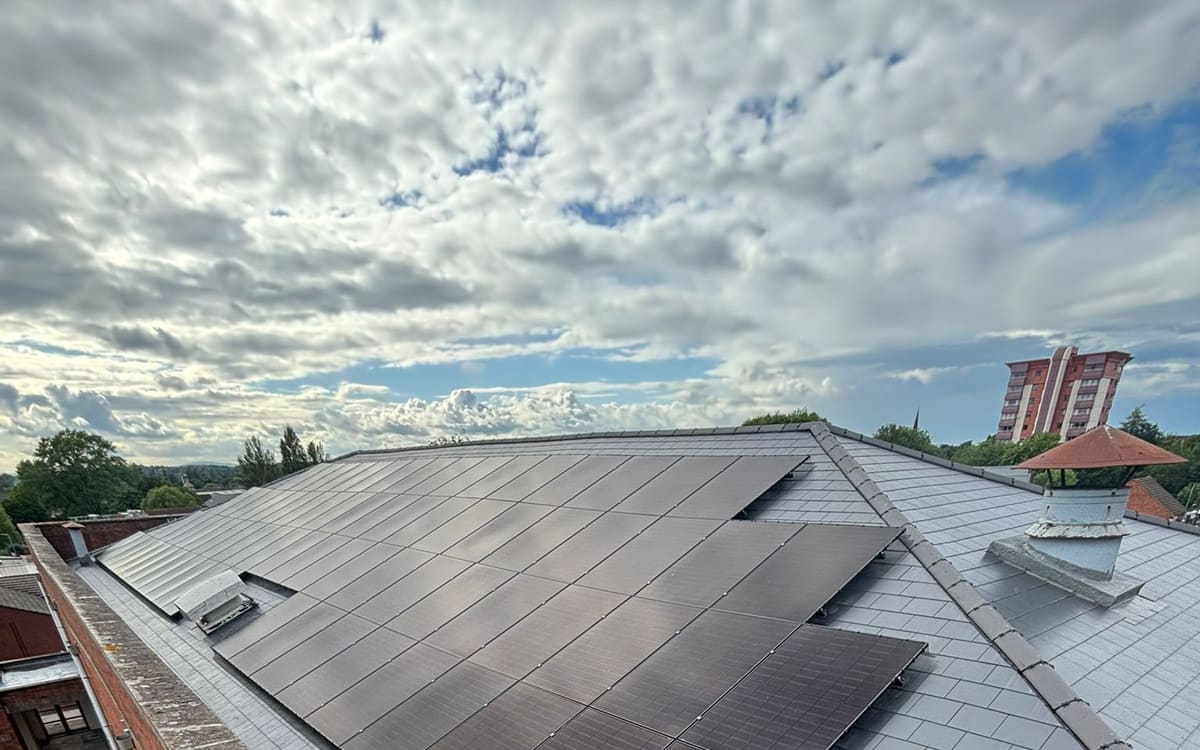
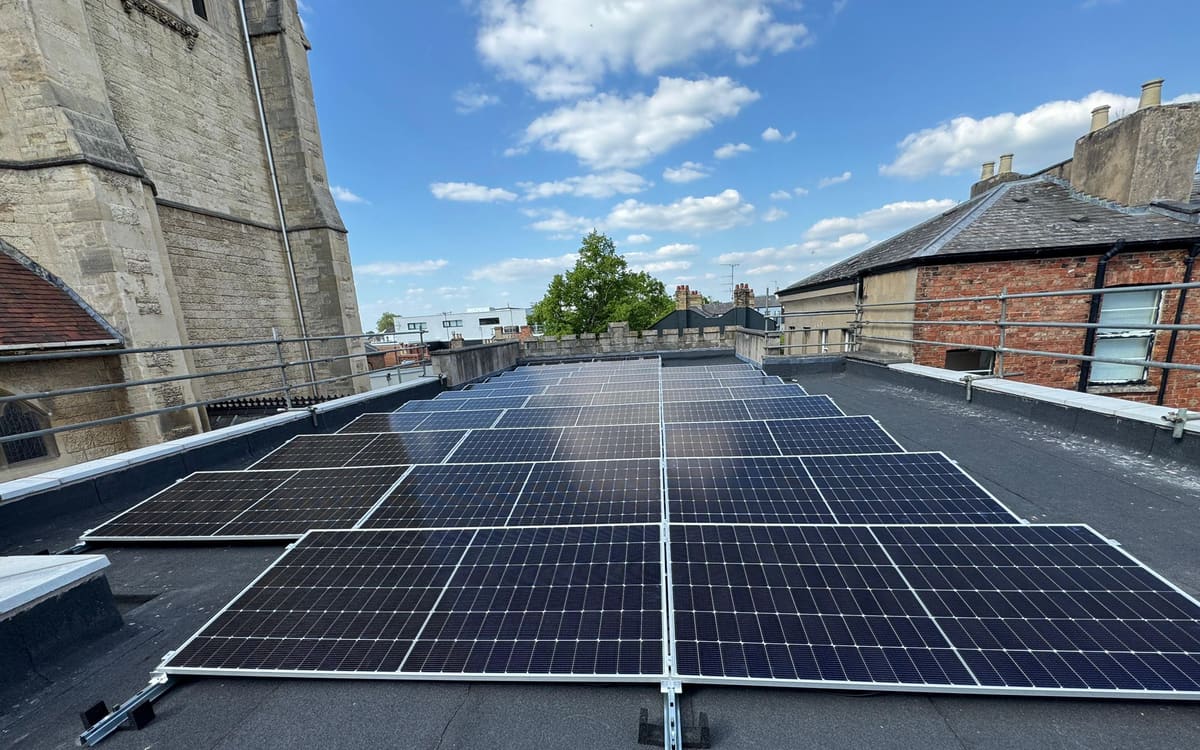
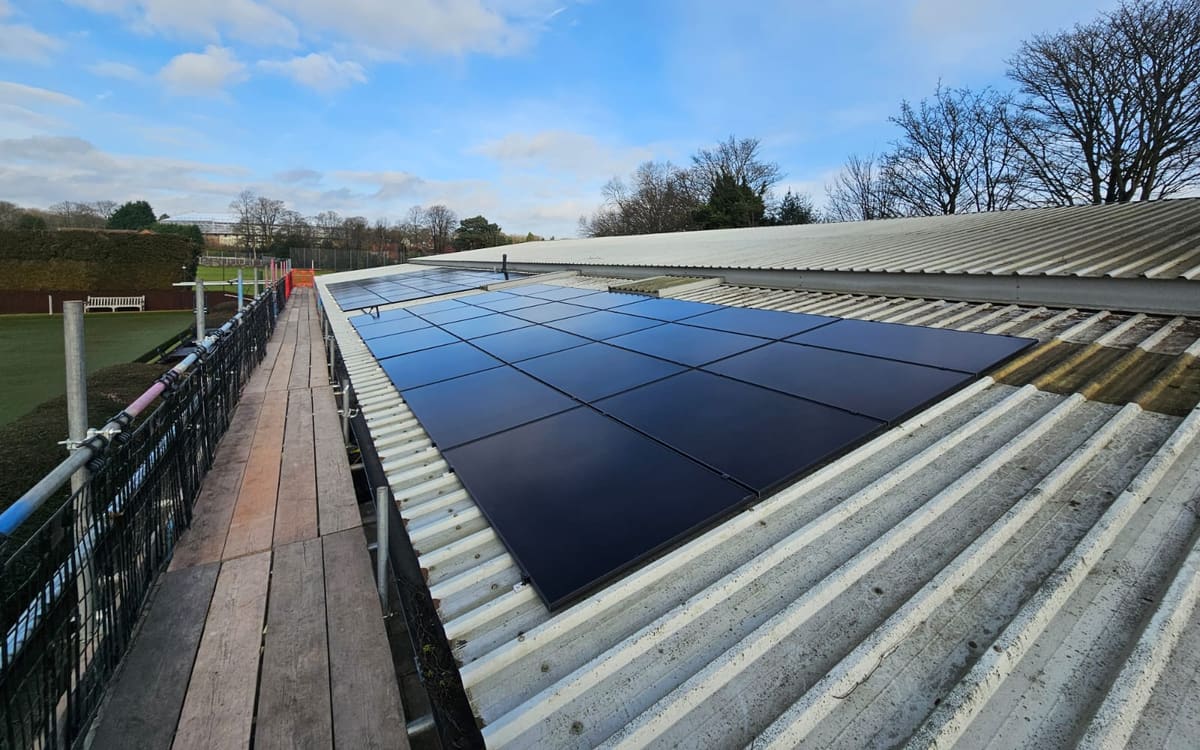
A 154 kWp rooftop array with 64 kWh of battery storage, sized to the daytime machinery load so generation is used the moment it is made.
MANUFACTURING · ROOFTOP PV
Director-led CAD design maximising yield on a complex industrial roof, the first of three Rapiscan installations Green Tech Hub has delivered.
Solar and storage projects delivered on commercial sites like these. See more in our case studies.
Specification
7 kW or 22 kW? Dwell time decides, not the datasheet.
The single most common overspend in commercial charging is buying power the vehicles will never use. Charging speed is capped by whichever is lowest: the charge point, the supply, or the car, and on AC the car is very often the limit, with a great many EVs accepting only 7 kW or 11 kW however fast the unit is rated. Twenty-two kilowatts also requires a three-phase supply at the bay, which not every site has where the parking is. So we specify from how long the vehicle sits still.
A 7 kW socket adds roughly 60–70 kWh overnight — more than most van batteries hold. Paying for 22 kW here buys nothing.
A full working day at 7 kW is a full battery. Load-shared sockets serve more cars from the same supply than a few unshared fast ones.
The one genuine 22 kW case — but only if the vehicle can take it. Many EVs accept 7 kW or 11 kW on AC no matter what the charger is rated at.
DC is a different cost and grid conversation entirely. We will tell you when your dwell times genuinely justify it, and when they do not.
Getting this right is also what keeps the business case intact, the same arithmetic we apply to commercial solar payback. Spend on sockets that get used, not on headline kilowatts that sit idle.
Funding
The Workplace Charging Scheme, plainly.
The Workplace Charging Scheme is a voucher-based government grant toward the purchase and installation of workplace charge points. It is genuinely useful money, and it is also frequently misdescribed, so here is what it actually covers.
The eligibility line that catches people out is the parking: it must be dedicated off-street parking associated with your premises and used by staff or fleet. Bays provided for customers or the general public are outside the scheme. Note also that the domestic 0% VAT rate on energy-saving materials does not apply to commercial premises, VAT-registered businesses normally recover it as input tax instead. Grant terms change; we confirm the current position for your site before you commit.
Best use of a roof
Charging on your own solar.
Vehicles are parked precisely when the roof is generating. That coincidence is why EV charging is one of the highest-value loads you can put on a commercial solar array: a West Midlands system yields around 900–1,000 kWh per kWp per year, concentrated in the middle of the day, and a unit you consume yourself is worth roughly three times a unit exported under the Smart Export Guarantee.
Add battery storage and the window widens further: solar generated at midday charges vans that only return at six, and off-peak import can be banked for a morning surge. Designed together, the three systems share one set of monitoring and one commercial case.
After the install
Software, billing and the twelve years that follow.
A charge point is a connected asset with a long service life, not a socket on a wall. Two decisions made at specification stage, which protocol it speaks and who can service it, determine whether you are still happy with it in year five.
OCPP, not a walled garden
We specify hardware speaking OCPP 1.6J or 2.0.1, so the charger and the management platform are separable. If the back-office contract stops working for you in three years, you change the software — not sixteen chargers.
Billing and reimbursement
Per-driver RFID or app authentication, per-kWh reporting for HMRC-friendly staff reimbursement, and tariffs for paid visitor bays. Fleet managers get the charging data by vehicle, not one lump on the site bill.
Monitoring and maintenance
Chargers are outdoor electrical equipment on your supply: they need periodic inspection, RCD and earthing verification to BS 7671, firmware updates and fault callout. We service what we install and monitor it remotely.
Chargers are covered by the same servicing discipline as our solar O&M and monitoring plans. For single units, home installs and general charge point work, see our EV chargers page.
Questions
Straight answers.
Anything else. Call 0121 661 6400 and speak to a director, not a sales team.
Will I need a grid upgrade to install EV chargers?
Usually not. The default assumption — that every socket needs its own full-rate capacity — is what generates the expensive DNO quote. In practice a measured load assessment plus dynamic load management, which shares your real-time spare headroom across the chargers, lets most commercial sites add charging inside the supply they already have. We only recommend a capacity application when the measured numbers genuinely require one.
Is 22 kW always better than 7 kW?
No — the right power is set by dwell time, not by the headline figure. A car parked for eight hours takes a full charge from a 7 kW socket; a 22 kW unit in the same bay costs more, needs a three-phase supply and finishes hours before anyone returns. It matters even less than people expect because many EVs only accept 7 kW or 11 kW on AC regardless of what the charge point can deliver. Short-dwell visitor bays are where 22 kW earns its keep.
Can my business claim the Workplace Charging Scheme grant?
If you are a business, charity or public sector organisation with dedicated off-street parking used by staff and/or fleet, and you own the site or have landlord consent, you are likely eligible. The grant is worth up to £500 per socket toward up to 75% of purchase and installation cost including VAT, capped at 40 sockets per applicant, and the scheme currently runs to 31 March 2027. Customer or public parking does not qualify. The claim goes through an approved installer alongside the installation rather than being submitted by you afterwards.
Does it make sense to run the chargers off our own solar?
For workplace and daytime fleet charging it is one of the strongest cases in commercial solar. A West Midlands roof produces roughly 900–1,000 kWh per kWp per year, mostly in the middle of the day — exactly when staff and visitor vehicles are parked. A unit you self-consume is worth roughly three times a unit exported under the Smart Export Guarantee, so charging vehicles onsite converts generation you would otherwise sell cheaply into fuel you would otherwise buy dearly.
What is the difference between this and your EV chargers page?
This page covers commercial installations: fleet depots, workplace car parks and visitor bays, where load assessment, load management, billing and grant funding all apply. Our general EV chargers page covers charge point installation more broadly, including home and single-unit installs. If you are not sure which applies, call and we will tell you in five minutes.
Proof
Real installs, real roofs.
Recent Green Tech Hub installations across the West Midlands. Every photo on this site is our own project, not stock imagery.
Plan your charging rollout
Tell us the site and vehicle numbers and we'll come back with a phased plan, grid capacity check and costed proposal.
Get your free, no-obligation quote
Commercial solar, battery, EV or any electrical work — no pressure.
Start with the supply.
Book a site assessment and we will tell you how many sockets your existing connection will genuinely carry, before anyone quotes you hardware.
Pure Offices, Broadwell Road, Oldbury B69 4BY · MCS NIC-600049 · RECC 00067281 · NICEIC
Green Tech Hub Ltd is an Introducer Appointed Representative (Financial Services Register No. 987950) of Phoenix Financial Consultants Limited ("Phoenix"). Phoenix is a credit broker, not a lender. Phoenix is authorised and regulated by the Financial Conduct Authority (FRN: 539195), and offers finance from its panel of lenders. All finance subject to status and credit checks.