
Commercial Battery Storage · Birmingham & the West Midlands
Battery storage for business, sized on your data.
A commercial battery does not save money because it is a battery. It saves money because it moves your energy out of the expensive half-hours and into the cheap ones, and that only works if it was sized against your real consumption. We model twelve months of half-hourly data before we quote a single kilowatt-hour.
The economics
What a commercial battery actually earns.
Domestic storage has one job: stop you buying electricity in the evening. A business battery has four or five, and they stack. This is the difference between the general solar storage page and a commercial design, on a half-hourly settled supply, when you draw power matters nearly as much as how much you draw.
If your meter is half-hourly settled, the grid charges you for the shape of your demand as well as the volume. Discharging across your worst half-hours pulls down the peak kW you import, which is the number several charges are set against.
Distribution Use of System charges are banded by time of day. The red band — typically weekday late afternoon into early evening — is the expensive one, commonly a few pence a unit more than green. A battery that carries you through that window every working day quietly saves money 250 days a year.
On a day/night or flexible contract, a battery charges overnight at the cheap rate and discharges across the costly daytime block. This is the one mechanism that works with no solar at all — it depends entirely on the spread in your tariff, so we check your actual contract before we claim it.
A kilowatt-hour you use on site displaces a full retail unit. A kilowatt-hour you export earns an SEG rate — roughly a third of that. Storage moves generation from midday into your evening, weekend and shoulder loads, and can lift self-consumption toward 80% on the right site.
Larger, remotely-controllable batteries can earn from DNO flexibility tenders, the Capacity Market or an aggregator stack. It is real money, but it needs scale, a controllable asset and a contract with an aggregator. We will tell you plainly whether your site is a candidate rather than building it into a payback figure you will never see.
Sizing
Sized from half-hourly data, never from a bundle.
Most battery quotes a business receives are packages, a round number of kilowatt-hours attached to a round number of solar panels. That is a sales structure, not an engineering one. Two identical warehouses on the same road can need completely different batteries because one runs a night shift and the other does not.
Our team has designed over 100 MW of solar, and every commercial battery proposal we issue is built the same way: your data first, the hardware second. If the numbers do not support storage, the proposal says so. See how the wider figures come together on commercial solar payback.
Book a free energy survey- 1 Pull twelve months of half-hourly data from your supplier or meter operator — not a spot reading, not an annual kWh figure.
- 2 Plot the real load: base load, shift patterns, weekend running, the half-hours where your peak actually lands.
- 3 Overlay modelled PV yield. In the West Midlands a well-oriented array returns roughly 900–1,000 kWh per kWp per year.
- 4 Test candidate battery sizes — both kWh of capacity and kW of power — against those real half-hours, not a brochure.
- 5 Put inverter and battery replacement into the payback maths before we show you a number.
- 6 Submit the G99 application to National Grid Electricity Distribution and agree the export limit.
Backup power
A battery does not automatically keep the lights on.
This is the single most common misunderstanding we correct on site visits. Businesses buy storage assuming it doubles as a UPS, and discover during the first outage that it shut down with everything else. That behaviour is deliberate and it is a legal safety requirement, but it can be designed around, provided somebody plans for it before the cable goes in.
A standard grid-tied battery is required to disconnect during an outage. Loss-of-mains and anti-islanding protection under G98/G99 exist to keep engineers working on a dead network safe.
Backup has to be engineered in: a hybrid inverter with an EPS output, a separate protected distribution board, and the critical circuits segregated onto it.
Decide what "critical" means before design — servers, cold storage, security, a production line, emergency lighting. Segregating them is electrical work, not a software setting.
Backup sizing and savings sizing are different problems. The battery that shaves your peak most cheaply is rarely the one that rides out a three-hour outage.
Straight talking
The parts of the maths nobody volunteers.
We have no traditional sales staff, directors and technically-minded surveyors run every project, which means nobody here is paid to talk you into a battery. These are the four things we raise on every commercial storage enquiry, including the ones that cost us the sale.
Batteries are working electronics
Panels are warranted for 25 years and commonly run 25–30. A commercial battery and its inverter are working electronics with a realistic service life nearer 10–12 years. Any payback model that ignores a mid-life replacement is not a payback model. Ours includes it.
A flat 9-to-5 load may not need one
If your site runs Monday to Friday, 9 until 5, with a flat profile and no evening demand, solar alone may already be consumed on site as it is generated. Adding storage to that would buy you very little. We have told businesses to skip the battery and spend the money on more panels — it is a shorter conversation and a better result.
Business rates: exempt to 2035
In England, eligible on-site renewable generation and storage plant is exempt from business rates until 31 March 2035. There is nothing to apply for — the Valuation Office Agency simply leaves the qualifying plant out of the rateable value.
VAT and capital allowances
The 0% VAT rate is a domestic measure and does not apply to commercial premises; a VAT-registered business normally recovers it as input tax. On allowances, solar and storage are special-rate plant, so they are excluded from full expensing — the routes are the 50% special-rate first-year allowance or the Annual Investment Allowance.
Allowances are set by your own tax position, take advice from your accountant. Full detail on capital allowances for commercial solar, and on export income under the Smart Export Guarantee for business.
Proof
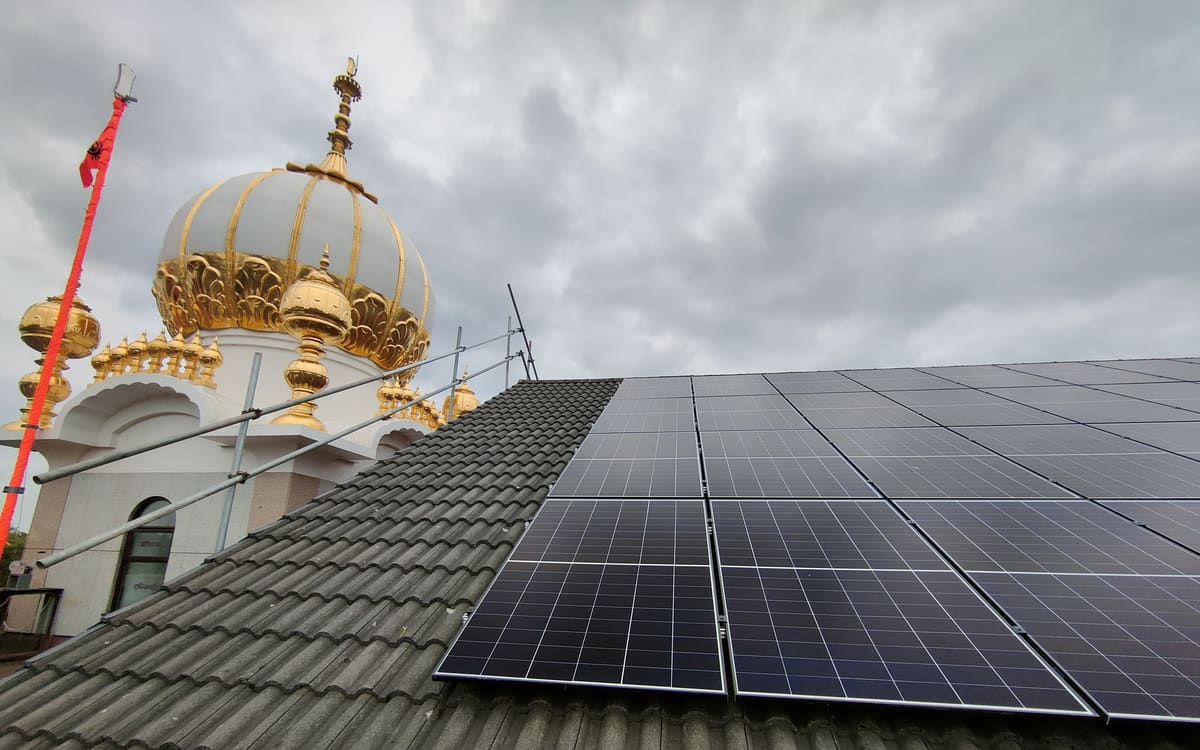
Guru Nanak Gurdwara — where storage earns its keep.
Solar plus battery storage cutting running costs for a busy seven-day community site in Smethwick, with storage smoothing the evening and weekend load. A seven-day community building is close to the ideal storage case: demand does not stop at five o'clock, the busiest hours are exactly the ones the grid charges most for, and weekend generation would otherwise be exported at a fraction of its value.
The same logic applies to hotels, care homes, gyms, food production and any site with an evening or weekend shift. If your load looks nothing like that, say so early. We would rather design the right system than the bigger one.
Buy cheap off-peak, use free solar, sell the surplus back to the grid.
Questions
Straight answers.
Anything else. Call 0121 661 6400 and speak to a director, not a sales team.
How much can a commercial battery actually save my business?
It depends far more on the shape of your load and the structure of your tariff than on the size of the battery. Savings stack from three places: avoided peak-time energy units, reduced network charges such as DUoS red band and capacity charges, and solar generation used on site instead of exported. We will not quote a figure until we have modelled twelve months of your half-hourly data — anyone giving you a saving before that is guessing.
How big a battery does my business need?
A commercial battery has two sizes that matter: capacity in kWh, which sets how long it can run, and power in kW, which sets how much load it can carry at once. Both come out of your half-hourly consumption profile and, if you have solar, the modelled generation curve. Sizing from a bundle or a rule of thumb is how businesses end up with a battery that is half empty every night or too small to cover the peak it was bought for.
Will a battery keep us running in a power cut?
Not by default. A standard grid-tied battery must disconnect when the grid goes down — loss-of-mains and anti-islanding protection are mandated so that nobody is back-feeding a network engineers are working on. Backup has to be designed in from the start using a hybrid inverter with an EPS output, a protected distribution board and your critical circuits wired onto it. Tell us at survey stage if outage cover matters and we will design for it.
How long does a commercial battery last?
Plan on a realistic service life of around 10 to 12 years for the battery and its inverter, against 25 to 30 years for the panels. Manufacturer warranties are usually written as a throughput or cycle count with a guaranteed remaining capacity at the end. Because the replacement falls inside the life of the solar array, we build it into the payback figures rather than leaving it as a surprise in year eleven.
Do I need permission from the network operator?
Yes. Commercial battery storage connects under a G99 application to your distribution network operator — National Grid Electricity Distribution across most of the West Midlands. The DNO assesses whether the local network can take the connection and sets your export limit. We prepare and submit the application, and we factor the lead time into the programme rather than starting work and hoping.
Are batteries liable for business rates?
In England, eligible on-site renewable generation and storage plant is exempt from business rates until 31 March 2035. The relief is applied automatically — the Valuation Office Agency excludes the qualifying plant from the rateable value, so there is no form to complete and no relief to claim.
Proof
Real installs, real roofs.
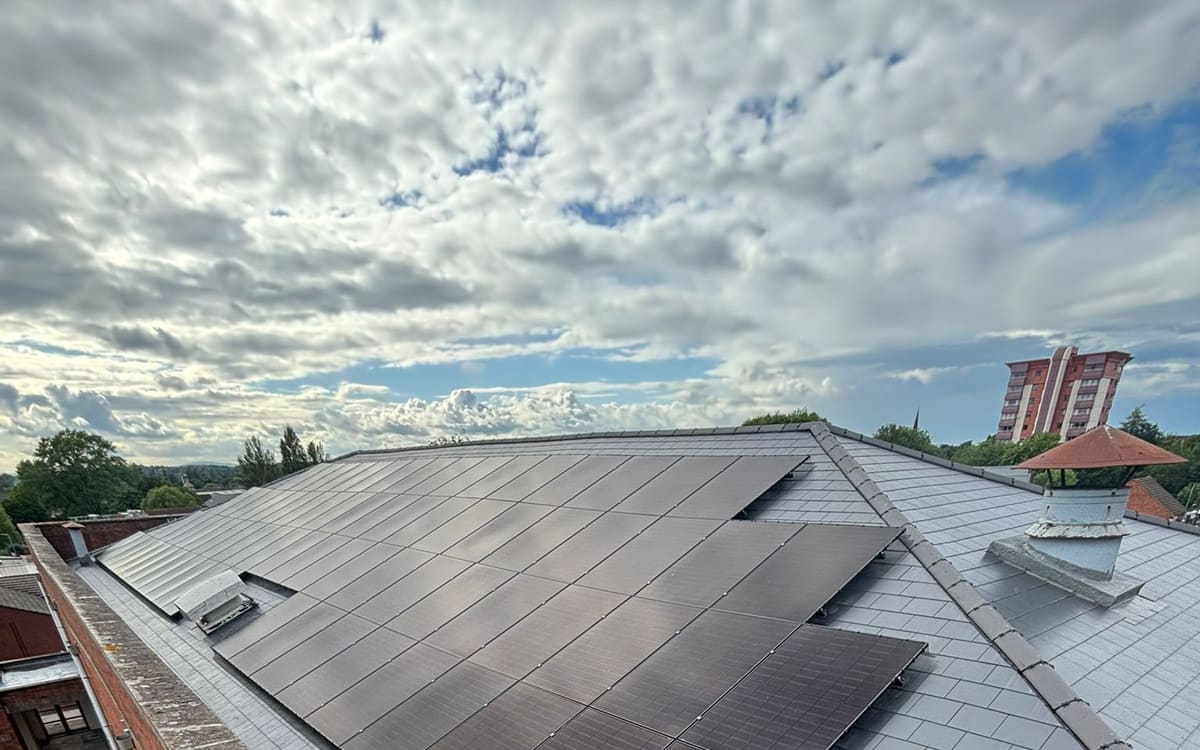
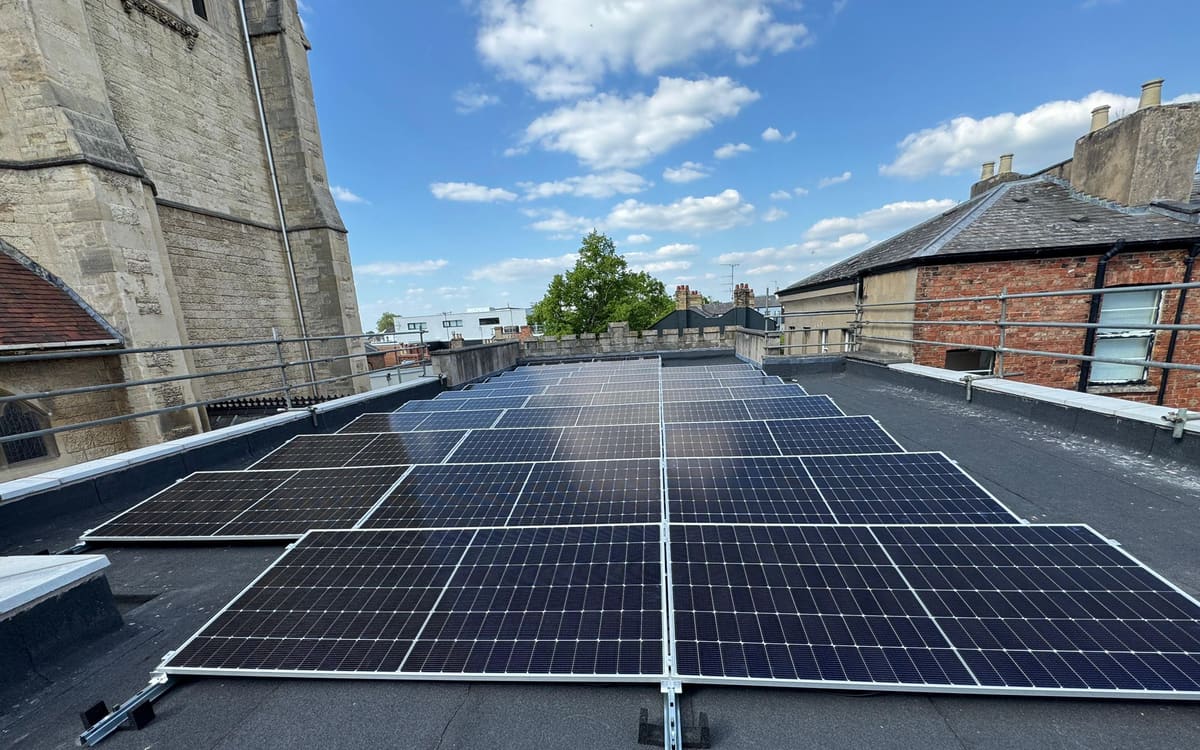
Recent Green Tech Hub projects, several combining PV with storage. Every photo is our own work, not stock imagery.
Model your battery payback
Send us your consumption data and we'll show what storage would shift off peak-rate tariffs, sized to your operating pattern rather than a brochure figure.
Get your free, no-obligation quote
Commercial solar, battery, EV or any electrical work — no pressure.
Send us your half-hourly data.
We will model it, size the battery properly and show you the payback with the replacement cost already in it. Free, and with no obligation — Oldbury-based, covering Birmingham and the West Midlands.
Funding options: commercial finance and fully funded PPA (installs above 100 kW), or start with commercial solar in Birmingham.
Green Tech Hub Ltd is an Introducer Appointed Representative (Financial Services Register No. 987950) of Phoenix Financial Consultants Limited ("Phoenix"). Phoenix is a credit broker, not a lender. Phoenix is authorised and regulated by the Financial Conduct Authority (FRN: 539195), and offers finance from its panel of lenders. All finance subject to status and credit checks.